Almardà, Corinto and Malvarrosa beaches in Sagunto: storm Adam reaches the dunes
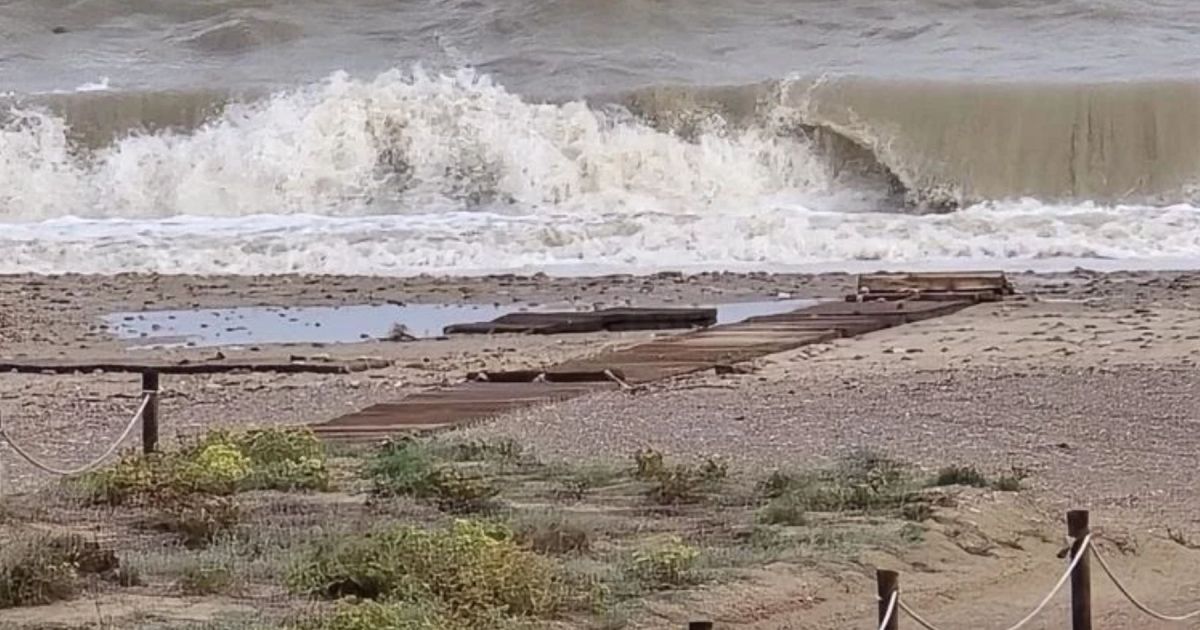
The dana Adam storm pushed the sea up to the dune ridge at Almardà, in Sagunto, and residents want the newly added sand protected by structures in the water.
The dana Adam (a severe cut-off low weather system) has put the regeneration of the beaches north of Sagunto through its first serious test. The swell it left behind reached the dune ridge at some points of Almardà, and the residents' association of Almardà, Corinto and Malvarrosa has responded with a statement addressed to the Ministry for Ecological Transition: the sand already added, it argues, is not enough on its own to protect the coast.
Almardà is an open beach of almost two kilometres, formed by stone, and its main attraction is the dune ridge of high ecological value on its western side. That strip is precisely what the sea has touched, only a few months after a regeneration that residents had demanded for years.
The scale of the works explains the unease. According to the association, the Ministry has moved about 1.3 million tonnes of sand. When the Secretary of State for the Environment visited the works in late April 2026, the figure reported by elperiodic.com was given as a volume: 1.217 million cubic metres, within a project costing 18,627,694.10 euros. The coastal authority (Costas) also expects the initial shoreline to retreat by between 50 and 60 metres until it reaches its equilibrium profile, so the new beach is designed to readjust over time.
The storm was not an isolated episode. The association counts two maritime storms in the first 19 days of October, almost one every ten days, and fears what the coming months may bring.
The residents' specific request is to study and build submerged breakwaters or artificial reefs parallel to the coast. The idea is that they would reduce the energy of the waves and help retain sediment. They ask that any work be carried out with technical and environmental guarantees. They acknowledge that the regeneration has restored beach area, so they do not challenge the project itself but consider it incomplete: without protection, they warn, their homes will remain exposed to storms.
Corinto is the focus of much of the discontent. Residents believe its erosion was made worse by earlier work on the nearby coast. Specifically, they question the removal of sediment from this area to regenerate the beaches of Almenara, which in their view stripped Corinto of part of its natural protection and left it more exposed to the waves. They also point to the groynes built at Almenara as a possible cause of changes in sediment transport along this stretch of coast. For that reason they ask the authorities to assess those effects and study corrective measures. This is the association's interpretation, not a published technical conclusion.
They are not the only ones doubting how long this kind of work lasts. In late July 2026, Valencia Plaza reported that Greenpeace's report «Destrucción a Toda Costa 2026» argues that sand additions fail to halt the retreat of the coastline, and it names Almardà, Corinto and Malvarrosa among its examples.
The association addresses the Ministry, the Coastal Demarcation (Costas) and the other competent administrations. It asks them for a concrete timetable and commitments to carry out structural measures, because it fears the regeneration will end up as a temporary fix for a problem with years of complaints behind it. The original report does not include, for now, a response from the Ministry or from Costas.
What is already on the table is the second phase mentioned in April: extending the Gola de Quartell (an outlet channel) and regenerating the dune ridge, the same stretch the swell has just touched. What remains unknown is the timetable for that phase and whether it will include any of the structures the residents are asking for.
According to El Periódico de Aquí, with additional data from Wikipedia on Almardà beach, from elperiodic.com on the works and from Valencia Plaza on the Greenpeace report.