Sagunto beach police showcased as a safety model at Blue Flag congress
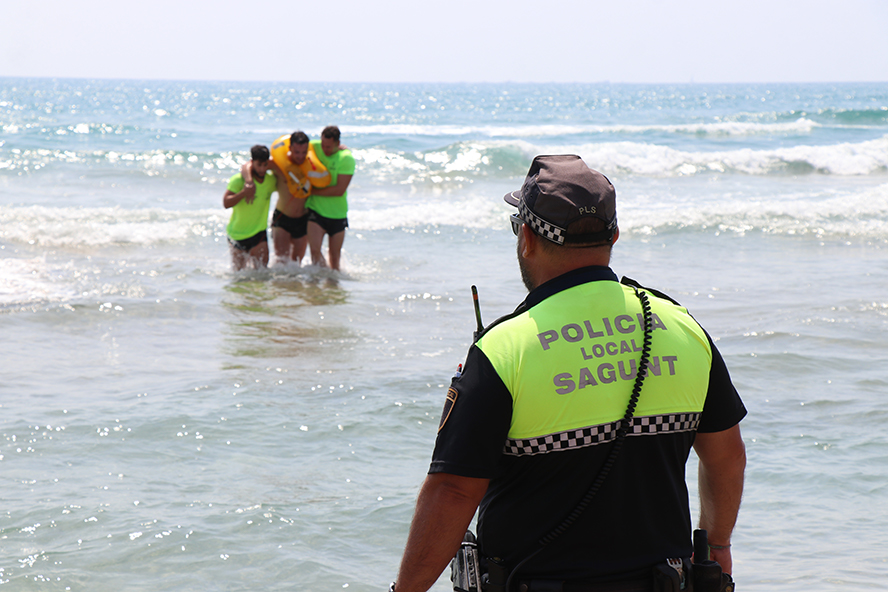
Sagunto's Local Police presented its beach service at the III International Blue Flag Congress in Islantilla (Huelva), built on patrols on foot, by quad bike and by boat.
A summer with no drownings and four beaches holding the blue award (Puerto de Sagunto, a coastal district, plus Almardà, Corinto and Malvarrosa) backed Sagunto Local Police's presence at the III International Blue Flag Congress, themed Sustainability, Health and Safety. The sessions took place in Islantilla (a seaside resort in the province of Huelva, south-west Spain) between 30 September and 2 October. There, inspector Antonio Pacheco, who coordinates the Beaches section, explained the local model to more than 200 people and, according to the council, several municipalities with the flag showed interest.
What was presented is a way of watching over beaches based on staying close: officers who cover the sand on foot, others who patrol the coastline by quad bike and others who go out to sea in a boat. The aim is twofold, to prevent and to respond at once. Around that patrol works the rest of the set-up: the municipal lifeguards, technical and medical assistance, the rescue drone and the accessible points.
The summer leaves these figures: 3,612 services by the Beaches section and zero drownings along the municipality's coast. There were also 43 fines for breaking the Beach Bylaw (the municipal rules on how beaches may be used), 35% fewer than last year (about 66 then, by simple arithmetic, so about 23 fewer), even though noticeably more people came. The council credits prevention and awareness work on the sand itself.
To see what lies behind that, the council's balance of 15 September helps: officers took part in 20 assistance cases with the lifeguards, located 6 people who had gone missing and found drifting packages holding about 2,200 grams of cocaine. According to elperiodic.com in September 2026, the summary also included 106 patrols on foot, useful for prevention and for talking to bathers, and checks on 5,224 vehicles at 10 speed points in Almardà, Corinto and Malvarrosa, about 520 per point. Added together, the 20 assistance cases and the 6 locations are 26 interventions to help people, compared with the 43 fines of the summer.
María José Carrera, councillor for Local Police, attributes the safety of Sagunto's beaches, which she ranks among the safest in the country, to the police's coordination with the lifeguards, and believes forums like this give value to the work of a force with very varied tasks. The congress also yields an educational video, recorded with ADEAC (Association for Environmental and Consumer Education), on how police work on the beaches. Its president, José Palacios, said it will be shared in several countries and reach every Spanish municipality with a Blue Flag.
Why a police force has a place at this event lies in the requirements of the Blue Flag, an award the Foundation for Environmental Education has granted since 1987 to beaches, marinas and boats. Four areas are assessed: bathing water quality, environmental information and education, environmental management and, finally, safety with its services and facilities. Sagunto's service falls under the last one.
Spain totals 794 awards in 2026, according to ADEAC: 677 beaches, 111 marinas and 6 tourist boats, which leaves it once more at the top of a programme running in 51 countries. Sagunto contributes 4 of those 677 beaches. More than 200 people from 71 municipalities, 21 provinces and 10 autonomous communities came to Islantilla; there were 45 speakers and a scientific committee of 30 doctors from 14 universities.
The council's note mentions no change to the service after the congress; what was presented is the model already under way.
According to aytosagunto.es and elperiodic.com, with additional data from Wikipedia on the Blue Flag.