Connecta amb la ciència in Puerto de Sagunto 2026: UJI workshops for 85 pupils
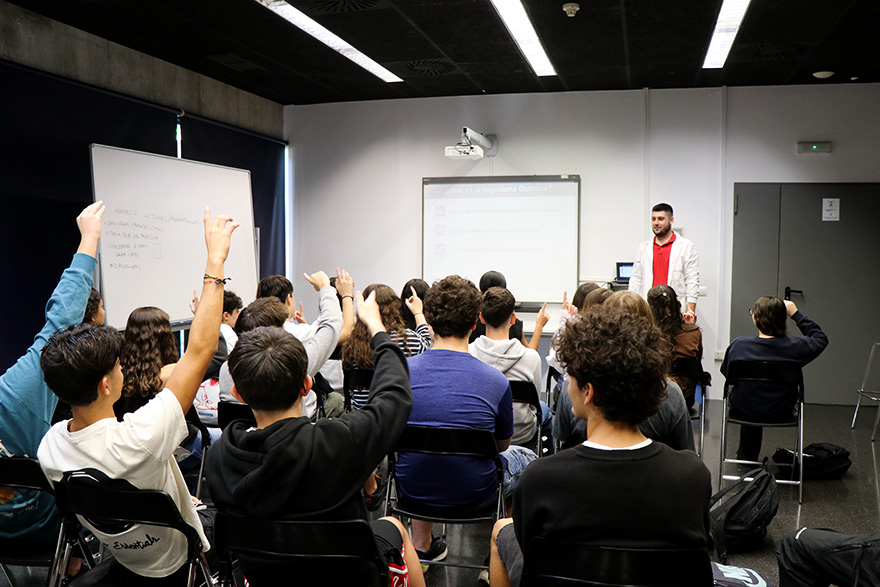
85 fourth-year ESO pupils from IES Altos Hornos have opened the new edition of 'Connecta amb la ciència' at the Casal Jove in Puerto de Sagunto, with UJI workshops.
The Casal Jove in Puerto de Sagunto (coastal district) hosted the start of a new edition of 'Connecta amb la ciència' on 20 October. Through the programme, the Universitat Jaume I (UJI) in Castellón offers secondary pupils practical workshops led by its researchers. For the fourth-year ESO pupils (aged about 15 to 16) taking part, the benefit is concrete: the opening day included demonstrations with a hydrogen-powered vehicle and a small wind turbine.
Sagunto City Council took part in the launch through its education councillor, Raúl Palmero, who accompanied Adrián Mota, the UJI's academic director for Knowledge Transfer and Exchange, at the welcome event.
The opening day brought together 85 students from IES Altos Hornos (a secondary school), split into four groups. The workshops were led by researchers from the university's School of Technology and Experimental Sciences. The UJI, founded in 1991, consists of three faculties and one school.
The programme was built around three activities. In 'A day in the life of an analytical chemist', organised by the University Institute of Pesticides and Water, the pupils went through the stages of a chemical analysis, from sample to result. The Multiphase Fluids group presented 'Visualising the invisible', where optical techniques make visible the currents of cold and warm air that go unnoticed by the naked eye.
The third, 'The hydrogen fuel cell', run by the Chemical Engineering and Materials Technology group, explained how fuel cells work. The pupils tried out a vehicle powered by hydrogen and a small wind turbine fed by an ethanol fuel cell.
'Connecta amb la ciència' began in 2012 with the aim of bringing research closer to young people and encouraging STEM vocations, meaning science, technology, engineering and mathematics. It is organised by the UJI's Science Outreach and Citizen Science Unit and its Campus Obert programme, with the collaboration of the Spanish Foundation for Science and Technology (FECYT), which depends on the Ministry of Science, Innovation and Universities. According to the UJI in 2023, the activities at the Camp de Morvedre district venue are part of the European project SCIENCE GTS, funded by the European Commission under Horizon MSCA and Citizens 2022.
Palmero argued that bringing science to students helps them steer their future careers, and linked the programme to the Science Week that the council has organised with the UJI for more than 17 years. He also had a message for girls: he asked them to break with gender stereotypes and choose freely, including engineering, computing or mechanics.
Mota thanked the council for its collaboration and encouraged students to approach science and technology in a practical and enjoyable way. He stressed the need to develop a critical attitude towards the information they receive online, and invited them to ask questions in the workshops and keep up their interest in these subjects.
The route is not new for Puerto de Sagunto. According to the UJI, the 2023 edition was also held at the Casal Jove, with workshops on optics and light and on hydrogen and fuel cells, two lines that return now with 'Visualising the invisible' and 'The hydrogen fuel cell'. Further back, as the UJI published in March 2015, the fourth consecutive edition, held from 2 to 6 of that month, brought together more than five hundred fourth-year ESO and sixth-form pupils from the Camp de Morvedre. Eight schools from Sagunto, Puerto de Sagunto and Benifairó de les Valls took part, with workshops on measuring pollutants, how plants breathe and how cold is produced artificially.
This year's edition does not end with the opening day. The programme at the Camp de Morvedre venue runs until Friday 23 October, with other schools from the area, among them IES La Vall de Segó and the San Pedro Apóstol school. The official summary speaks of seven schools in total and more than a hundred students, who will attend workshops on materials technology, chemistry and design prepared by five UJI research teams.
According to Sagunto City Council and elperiodic.com, with additional data from the UJI and Wikipedia.