Zaragoza-Teruel-Sagunto line electrification: Spanish government authorises €51 million tender
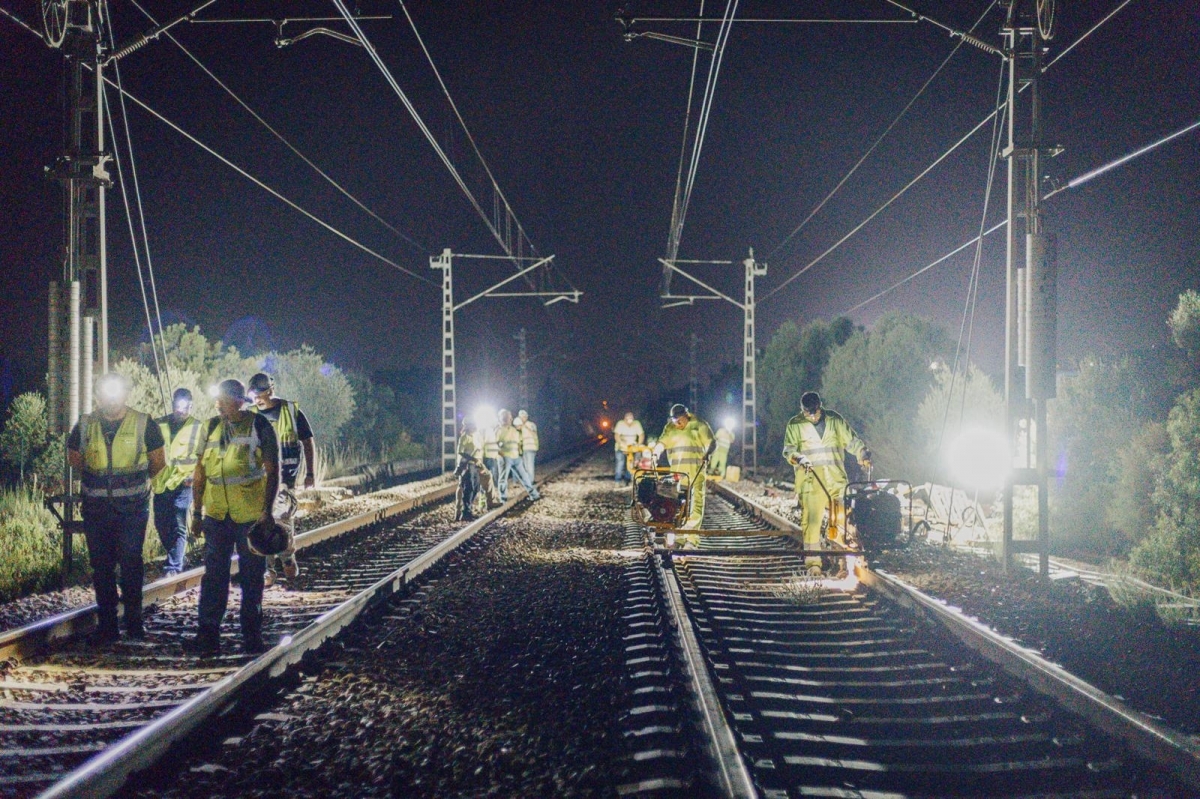
Spain's Council of Ministers authorised a tender on 20 October for electrifying the Teruel-Sagunto section: almost 130 kilometres and 51 million euros. With it, the 311-kilometre route to Sagunto will be electrified at 25 kV.
The Spanish government has cleared the way to put out to tender the work that will complete the electrification of the Zaragoza-Teruel-Sagunto railway line. The Council of Ministers, meeting on Tuesday 20 October 2026, authorised the Ministry of Transport and Sustainable Mobility to tender the contract for the Teruel-Sagunto section, valued at 51 million euros. The overhead line will run for almost 130 kilometres and, once the whole route is finished, trains will run on 25 kV from Zaragoza to Sagunto.
The contract covers the foundations for poles and anchors, with excavation and concrete pouring, raising the poles and stringing the supporting wire and the contact wire. Brackets, stays, compensation equipment, connections, insulators, mechanical and electrical sectioning, droppers, feeders, disconnectors and protection equipment will also be installed. Power will come from two substations, La Puebla de Valverde and Segorbe; the latter is newly built and part of the project.
In Castellón province, the overhead contact line will cover 59 kilometres through Barracas, Torás, Viver, Benafer, Caudiel, Jérica, Navajas and Segorbe. The route also crosses another six municipalities in Valencia province and two in Teruel. Alto Palancia is the district of Castellón through which the line runs.
While the tender is processed, Adif (Spain's state rail infrastructure manager) continues preparatory work between Teruel and Sagunto: adapting the clearance of 22 overpasses and nine tunnels to the parameters required for electrification, and installing new control, command and signalling systems at the 15 stations on the route. Of nine centuries-old stone bridges, three have been saved and will be rebuilt at another location.
The schedule points to summer 2027 for finishing the works. That date coincides with the closure of the track between Castelló and Vandellòs, which will be converted to international gauge: during that period freight traffic will be diverted along the Zaragoza route to reach Barcelona. Earlier, in June 2025, Diario de Teruel reported that Adif was aiming to have electric trains on the line by the end of 2026. On that evidence, the current reference, summer 2027, is a few months behind that target.
At the other end of the route, Adif is making progress on electrifying more than 180 kilometres between Teruel and Zaragoza. The substations at Cariñena and Villafranca are being built there, new control, command and signalling systems are being introduced along with traffic control devices, a siding for 740-metre trains is being prepared at Cella, and a level crossing is being removed in the municipality of Teruel. That section has had a contractor since January 2024, when, according to energias-renovables.com, Adif awarded it to a joint venture of Eiffage Energía Sistemas and Telice for more than 34 million euros. In July 2024, valenciaplaza.com also reported another government authorisation, of 37.8 million euros, for complementary works, including extending track 2 of the Cella siding to 750 useful metres.
The master plan for the 311-kilometre line aims for better interoperability and reliability, more capacity and more speed with more competitive journey times, as well as fewer incidents and more rational maintenance. For freight, it will allow more load per axle and sidings for 750-metre trains. In environmental terms, electrification will avoid about 5,000 tonnes of CO2 each year and the use of 2.1 million litres of diesel. The project may receive co-financing from the European Union's Connecting Europe Facility (CEF).
At the Sagunto end, Sagunto station already serves long-distance, regional and Cercanías (commuter) trains, with lines C5 (Valencia-Sagunto-Caudiel) and C6 (Valencia-Castelló). The rail link between the interior and Puerto de Sagunto (coastal district) also has a mining precedent: in 1907 a railway was opened from Sierra Menera to the port to carry iron ore, although that was a mining line and not the one now being electrified.
The next step is publication of the tender and its later award; with the information available it is not yet known which companies are bidding or when work on the section will start. No changes to passenger timetables or frequencies have been detailed either: the announcement focuses on infrastructure and freight traffic. According to Valencia Plaza, with additional data from Wikipedia. Complementary data: valenciaplaza.com, energias-renovables.com and diariodeteruel.es.