Sagunto asks to recognise Eliseo Sanchis as a victim of Franco-era repression
Sagunto's council has asked Spain's Ministry of Territorial Policy and Democratic Memory to recognise Eliseo Sanchis López, a socialist councillor shot at Paterna in 1939, as a victim of Francoism.
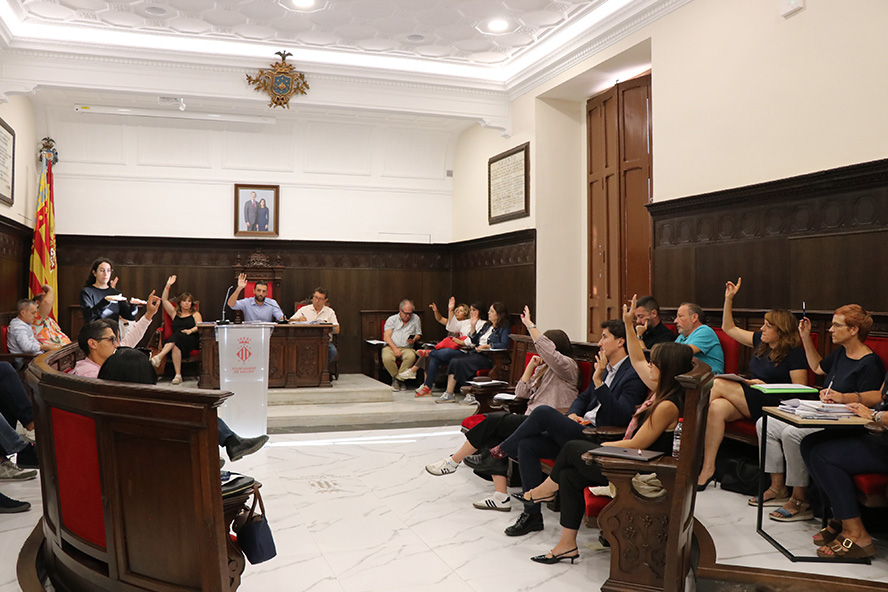
At its October session, Sagunto City Council approved a motion to recognise Eliseo Sanchis López as a victim of Franco-era repression, under the Democratic Memory Law. The text also asks the Ministry of Territorial Policy and Democratic Memory to grant him the Declaration of Recognition and Personal Reparation.
The proposal came from the groups PSPV-PSOE, Compromís per Sagunt and EU-Unides Podem, and Mayor Darío Moreno presented it to the plenary session. It passed with votes in favour from PSOE, Iniciativa Porteña, Compromís per Sagunt and EU-Unides Podem. The PP abstained and Vox voted against.
According to the motion's statement of reasons, Sanchis was born on 30 July 1891 in La Font de la Figuera and settled in Puerto de Sagunto (the coastal district) to work in the steel industry. He worked for the Compañía Siderúrgica del Mediterráneo (Mediterranean Steel Company), where he became foreman of the coke-oven plant. That company was set up in Bilbao in 1917 as a subsidiary of Altos Hornos de Vizcaya to run the Sagunto works.
His life was tied to the local labour movement: he belonged to the metalworkers' section of the UGT union and to the city's Socialist Group. During the Civil War he sat on the United Popular Front Committee and the Defence Committee, and served as a councillor for the PSOE between 30 November 1936 and 27 September 1937. That time on the council is why, according to the motion, the town hall feels a special responsibility towards him.
When the war ended he was arrested and held in an orange warehouse that had been turned into a prison in Sagunto. A court martial on 19 August 1939 sentenced him to death. He was shot at Paterna on 8 November that year, aged 48.
Paterna is where many Valencian victims of repression ended up. Between 1939 and 1956, 2,238 people were shot at its cemetery and thrown into more than 100 mass graves, almost half of all those repressed in Valencian territory and coming from 191 municipalities, according to the educational programme of the L'Etno museum, run by the Diputación de València (provincial council). Scientific exhumations began in 2017 and, according to the same programme (2023-2024), had recovered about 1,200 victims. That figure dates from then and is not a current count.
The motion notes that, 85 years after the execution, Sanchis's family has recovered his remains and been able to give him the burial they longed for. It credits the work of the Paterna Mass Graves Families Platform and the democratic memory policies of the Spanish government.
What the requested declaration would change: according to the Ministry, it has three elements, recognition as a victim, a declaration, where applicable, that the court that convicted was illegal and illegitimate, and the nullity and illegality of the sentence. For a case like Sanchis's, tried by a court martial in 1939, the last two points matter most to the family. The Ministry itself reported on 18 November 2025, three years after Law 20/2022 on Democratic Memory, that it had already granted and delivered 1,614 such declarations. The decision rests with the Ministry: the council vote only requests it.
The council has acted before on this subject with other residents. As elperiodic.com reported in August 2022, the Historical and Democratic Memory department was looking for relatives of two Sagunto residents shot at Paterna in 1939, José Sanchis Torrent and Hipólito Delgado Ferrer, for DNA tests. That is a different case from Eliseo Sanchis. And as eldiario.es reported in May 2016, Sagunto paid tribute to 27 people executed on 5 May 1939, whose names appear on a tomb in the municipal cemetery.
With this initiative the council wants to contribute to Sanchis's moral reparation, support his family and keep his story within the town's collective memory, under the principles of truth, justice, reparation and guarantees of non-repetition. According to aytosagunto.es and elperiodic.com, with data from the Ministry of Territorial Policy and Democratic Memory, the L'Etno museum, Wikipedia, and elperiodic.com and eldiario.es for the background.