Sagunto honours Empar Ríos and Maria Pozuelo, FJFS Falleras Mayores
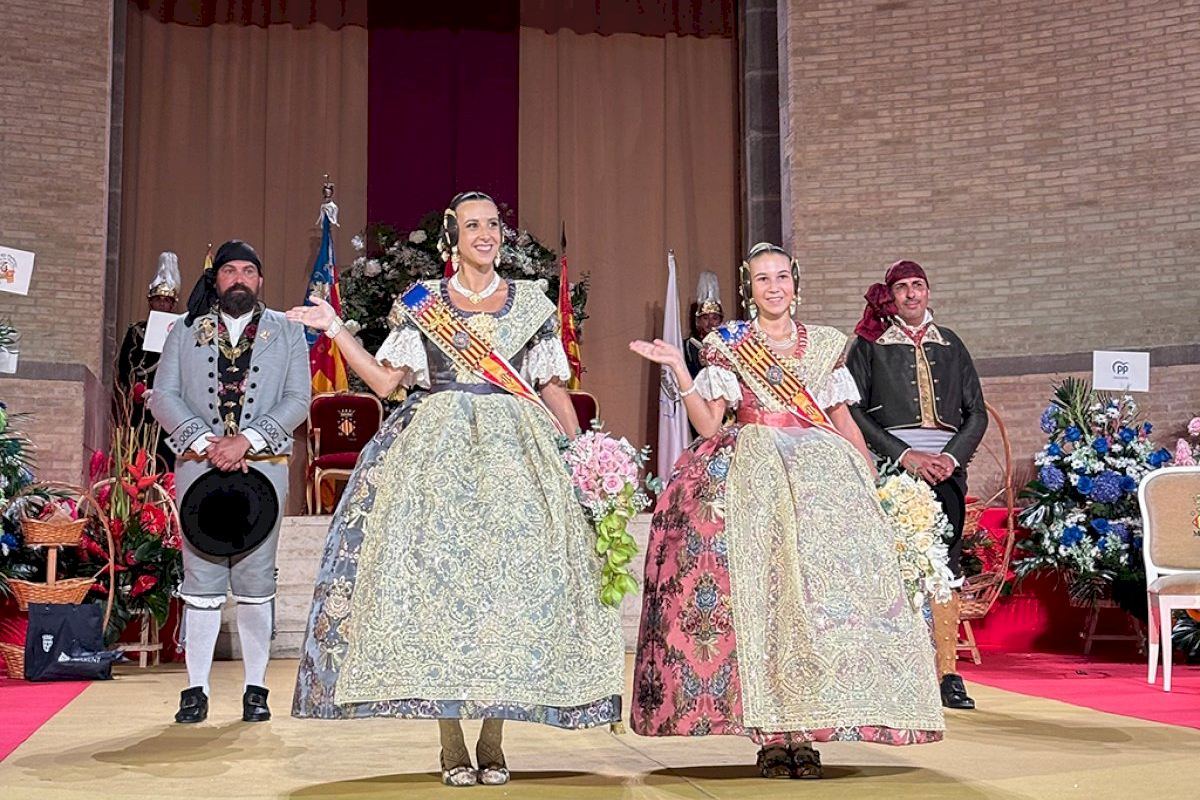
Sagunto's Roman Theatre hosted Saturday's Exaltación, the honouring ceremony for the Falleras Mayores of the FJFS Fallas federation, with Empar Ríos and Maria Pozuelo as guests of honour and journalist Pere Valenciano as master of ceremonies.
Sagunto's Roman Theatre once again hosted, last Saturday, 26 September, one of the most notable events on the city's Fallas calendar: the Exaltación of the Falleras Mayores of the Federació de Junta de Falles de Sagunt (FJFS), the federation that brings together the city's Fallas associations. Set for 6pm, as the federation had announced days earlier, the ceremony's guests of honour were Empar Ríos and Maria Pozuelo, this year's Falleras Mayores, with journalist Pere Valenciano acting as mantenedor (master of ceremonies). The venue, one of the city's best-known heritage sites and the usual setting for this kind of official Fallas event, filled with the public once again for the occasion.
Valenciano, a journalism graduate and founder of El Periódico de Aquí, an outlet specialising in Valencian culture and festivals, gave the evening's central speech. In Fallas tradition, the mantenedor delivers the literary piece that gives the event its formal meaning, praising the role of the Falleras Mayores as representatives of the festival and of the associations that make it up throughout the season, from the run-up events to the Cremà (the burning of the Fallas monuments) in March.
The FJFS, which organised the Exaltación, was founded in 1971 as the Junta Local Fallera and became, in 2012, following its 5th Fallas Congress, the federation of cultural Fallas associations it is today. It now brings together 30 comisiones (local Fallas associations) across Sagunto, Puerto de Sagunto, Gilet and Faura, a reach that goes beyond Sagunto itself and shows the real scale of the festival Empar Ríos and Maria Pozuelo will represent during their term. Sagunto's Fallas have also been officially recognised as a Fiesta de Interés Turístico Nacional (Festival of National Tourist Interest) since 2013, an official recognition that adds institutional weight to events like this one.
Saturday's ceremony comes three months after the federation said goodbye to the previous Falleras Mayores, Ana Martínez Llopis and Noa Barea Encinas, at an event held on 5 June at the Joaquín Rodrigo Auditorium, as elperiodic.com reported at the time. Each of them was accompanied by a six-member Corte de Honor (court of honour), with representatives from all 30 local associations, in a farewell the federation itself described as closing a year full of experiences. In a way, Saturday's Exaltación marks the reverse process: the start of the term for the Falleras Mayores who succeed Martínez and Barea at the head of the festival for the season leading up to the next Fallas.
The Exaltación ceremony keeps, year after year, a few elements that have become traditions of the event, including the surprise reveal of the gala dress the Falleras Mayores will wear for the first time. In the 2024 edition, as fjfs.es reported at the time, that year's Fallera Mayor, Teresa Aparicio, wore a black dress named Lampazo Alcázar, while the Fallera Mayor Infantil (the junior title-holder), Julia Palanca, wore an imperial grey silk dress called Sant Alfredo; that edition also had to be postponed because of the weather forecast, forcing organisers to reschedule the whole event. The federation usually keeps the chosen design under wraps until the day of the ceremony itself, keeping that surprise element as one of the most anticipated moments for the crowd that fills the Roman Theatre every year.
For the 30 associations that make up the FJFS, the Exaltación works as the official starting gun for the Fallas season, the moment Empar Ríos and Maria Pozuelo publicly take on their role at the head of the festival until the next Cremà. Over the coming months, both will represent the federation at official events, programme presentations and meetings with local Fallas associations, a role that combines institutional representation with closeness to the festival's associations. In the coming weeks, more detail is expected on the make-up of their respective Cortes de Honor and the calendar of run-up events that, as every year, will lead the way toward the Fallas in March, the festival that every spring fills the streets of Sagunto, Puerto de Sagunto, Gilet and Faura with fireworks, music and monuments.
According to elperiodic.com, with data from fjfs.es and the Federació de Junta de Falles de Sagunt.