Sagunto ends summer at its beaches with zero drownings and fewer fines
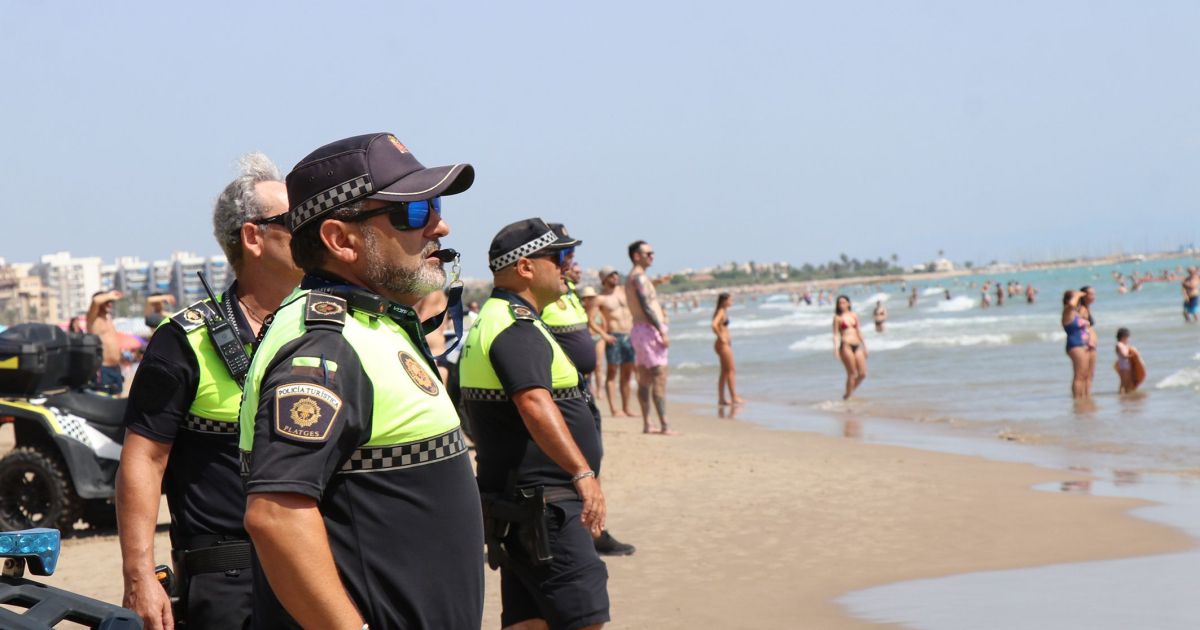
Sagunto's Local Police logged 3,612 beach patrol actions this summer, with no drownings and 35% fewer fines for rule-breaking than last year.
Zero drownings on Sagunto's beaches all summer long: that is the headline figure from the Local Police's Beach Section as it wraps up the season, having logged 3,612 actions along the coastline — almost identical to last year's 3,634. What has changed is the number of penalties: fines for breaching the Beach Bylaw (Ordenanza de Playas) fell by 35%, down to 43, even as the number of beachgoers kept rising.
Why did fines fall while more people hit the sand? The Local Police credit prevention over punishment: throughout the season, officers walked the coastline on 106 separate foot patrols, a method designed to stay close to people out for a walk or a swim rather than simply watching from a vehicle. The breakdown of the 43 fines shows where enforcement stepped in when prevention wasn't enough: twenty were for swimming under a red flag, twelve for loose or potentially dangerous dogs, three for unauthorised fishing, three more for parking on the dunes, three for unauthorised camping and two for playing music too loudly.
Behind the overall figures lies a snapshot of how tourist pressure splits between Sagunto's two coastal areas. Almost exactly half of all actions, 1,825, were concentrated along Almardà, Corinto and Malvarrosa, while the Port de Sagunto (Puerto de Sagunto) beach absorbed 1,785. In both areas, officers did more than issue fines: they also backed up 20 rescues alongside the Lifeguard and Rescue Service and helped reunite six people who had gone missing — including both minors and elderly beachgoers — with their families.
The rest of the report paints a picture of a season full of behind-the-scenes activity that rarely makes headlines: 134 anglers identified fishing in swimming zones, 162 animal-related checks, 164 actions against unlicensed street vending, and 384 matters resolved directly at the beach police post. Traffic in the coastal area also kept officers busy, with 849 violations corrected and 138 actions against unauthorised camping. Ten speed checkpoints set up in Almardà, Corinto and Malvarrosa — at residents' explicit request, tired of cars speeding through their streets — screened 5,224 vehicles: one in seven, 14%, was going faster than allowed.
On the public-safety side, the tally came to four arrests, four fewer than the previous summer, and two pickpocketing incidents. What did rise were violations linked to drinking or drug use on the sand: 19 cases, up 50% from 2025. The summer's most striking episode, however, had nothing to do with beachgoers: in two separate operations, officers recovered packages adrift at sea containing around 2,200 grams of cocaine, which were handed over to the national agency responsible for drug trafficking.
The Beach Section also did its part in Sagunto's major summer events, supporting operations for Saint John's Night (Noche de San Juan), the solar eclipse and the Cucañas Marítimas maritime games, backed by a surveillance drone and an advanced command post. Its social media channels, which shared daily flag status and weather forecasts, reached more than 1.4 million people over the summer.
That work has already crossed the municipality's borders: the unit has been invited to the 3rd International Blue Flag Congress, held in Huelva, in recognition of how it organises its coastal service. It is not a one-off relationship — Sagunto maintains an ongoing partnership with Blue Flag Spain (Bandera Azul España), ADEAC and the International Group of Activities for Prevention and Lifesaving (GIAPS), the network that in 2026 awarded 794 Blue Flag distinctions across Spain (677 beaches, 111 marinas and 6 tourist boats), making the country the world leader in the programme since 1987, with the Valencian Community (Comunitat Valenciana) topping the regional ranking thanks to its 164 flags.
Closing the summer with zero drownings, in a season when the number of people visiting the municipal beaches kept growing, is exactly the kind of figure the Tourism department likes to use when promoting Sagunto's coastline to families looking for well-supervised beaches with a reputation for safety, beyond the plain scenic appeal of Almardà, Corinto, Malvarrosa or Port de Sagunto.
For residents living along the coastline, that international cooperation mostly translates into very concrete things: more visible police presence, more checks, and a faster response when it is needed — precisely the elements that let this summer's season close without a single drowning.
The councillor for Local Police, María José Carrera, praised the work carried out during the summer's heatwaves and stressed that combining prevention with information was decisive in closing the season without a single drowning, adding that beach safety will remain a municipal priority. According to El Periódico de Aquí, with additional background from Wikipedia.