Ciutat de Sagunt prizes 2026 in Valencian: Casado, Broseta and Micó win with record 242 entries
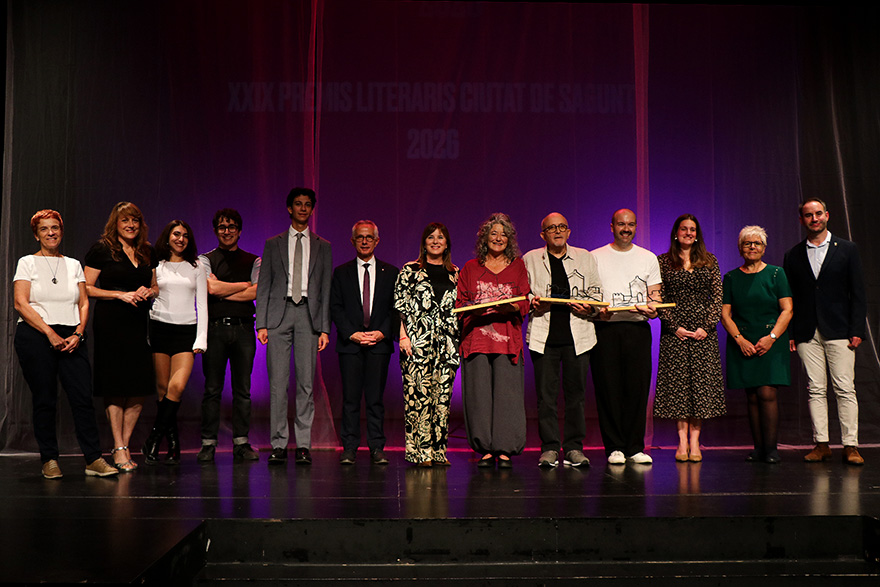
Jordi Casado, Teresa Broseta and Josep Micó win the 2026 Ciutat de Sagunt literary prizes for theatre, fiction and poetry, with a record 242 works submitted.
A total of 242 original works reached this year's Ciutat de Sagunt literary prizes, 65% more than in 2025. It is the third year in a row that the participation record has been broken, according to the call for entries the Sagunto City Council published on 1 July 2026. Poetry was the busiest genre with 105 works, followed by fiction with 79 and theatre with 58.
The Gabinet de Promoció del Valencià (the council's Valencian-language promotion office) handed out the awards on 23 October 2026 at the Centro Cultural Mario Monreal. The company Camí de Nora hosted the ceremony. All three winning texts are written in Valencian, one for each competition.
In theatre, the 23rd Pepe Alba Theatre Prize went to Jordi Casado Olivas for 349 metres. Casado was born in Barcelona, graduated in Stage Direction and Dramaturgy at Eòlia ESAD and studied European Theatre Arts at the Rose Bruford College in London. His text asks what exactly a home is inside a city and how to feel at home in a society that is increasingly turned into a tourist destination, uprooted, hostile and short of hope.
The winner of the 28th Ciutat de Sagunt Fiction Prize is Teresa Broseta Fandos, with Llevat de la memòria. Broseta holds degrees in Education Sciences from the Universitat de València and in Hispanic Philology from the UNED (Spain's national distance university), and has published fiction, theatre for adults and children's literature since 2001. Her earlier titles include La botiga del Carme, El flautista valent, Bruixots per un dia and El cor dels ibers.
The 29th Jaume Bru i Vidal Poetry Prize, the oldest, since the call began when the Gabinet was created in 1997, went to Josep Micó Conejero for Jardí de magranes. Born in Antella, Micó holds degrees in Philosophy and in Education Sciences and has contributed to magazines such as La Lloca, from Antella, and Kamchatka, from the Universitat de València. His collection traces homoeroticism from antiquity to today through art, historical figures and events that serve as shared reference points.
Besides money, the three winners get their work published. Fiction carries 8,000 euros and theatre and poetry 5,000 each, 18,000 in total. According to the call for entries, the council raised the awards this year: in 2022 they were 7,000 euros for fiction and 4,000 for each of the other two, 15,000 in all, so the total is up by 3,000 euros.
Each competition had a jury of three. In fiction, the writers Manel Joan Arinyó, Raquel Ricart and Josep Usó. In theatre, the actors or playwrights Marcos Sproston, Arantxa Cortés and Manuel Maestro. In poetry, the poets Manuel Bellver, Lola Andrés and Josep Porcar.
The Gabinet's councillor, Patricia Sánchez, used the event to defend the municipal policy on the language. She said the ceremony celebrates literature and also a language that keeps growing thanks to those who write and read it, and that culture is defended through actions, presence and involvement rather than speeches. She also said that, amid cuts and a lack of institutional sensitivity towards what identifies us, these prizes carry double value. In her view, town halls have a civic duty to step forward in defending and promoting Valencian when other authorities step back; the council's report does not specify which ones she meant. She concluded that a language does not stay alive just by looking back, and that it must keep being written, read and used in daily life so that it serves to create and tell stories.
The 2022 edition, the 25th, shows how far participation has jumped. As elperiodic.com reported in October 2022, 96 original works were received then from the whole Catalan-speaking area, 35% more than the year before, and poetry was already the busiest category with 44 manuscripts. The 242 of 2026 are more than double that, and the 105 poetry entries are more than double those 44. That year the winners were Sílvia Navarro in theatre with Galilea Glam, Àngel-Octavi Brunet in fiction and Susanna Lliberós in poetry with El crit.
According to the Sagunto City Council, with supplementary data from elperiodic.com on the 2022 edition.