Prefab classrooms at Sagunto's IES Altos Hornos school highlight space shortage
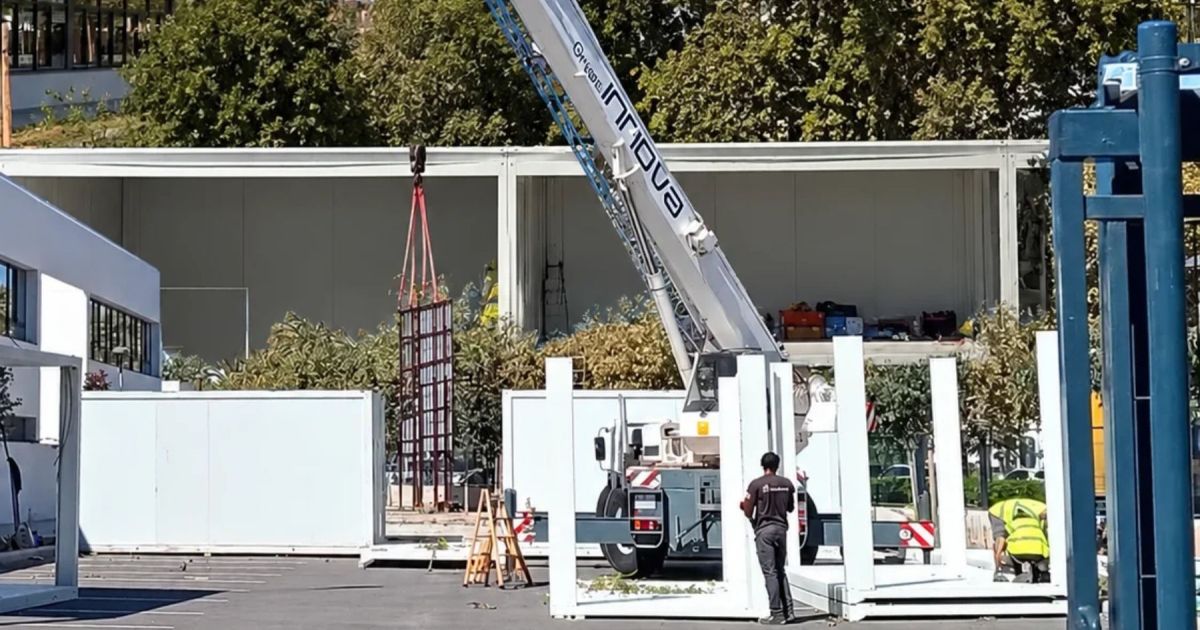
Sagunto's IES Altos Hornos school has installed temporary classrooms after 341 extra enrolments this term, and the PSOE, Compromís and PP parties all want new schools and the Eduardo Merello centre renovated.
At IES Altos Hornos school, in Puerto de Sagunto (the coastal district), the term has started with prefab modules in the playground, an immediate fix for a shortage of places that no party in town now disputes. The PSOE, Compromís and PP, despite very different platforms, are now asking almost in unison for more school buildings in a city whose pupil numbers are growing faster than its classrooms. The PSPV puts the figure at 341 out-of-schedule enrolments handled in the first two months of term, against 850 for the whole of last year; if the pace continues, this year's total could near 1,000.
All three parties wanted their proposals debated at Thursday's full council session, but it will not go ahead: the red rain alert declared across the Valencian Community forced its postponement, so the debate on Sagunto's schools and secondary schools will have to wait for the next one.
Where the three parties agree, even if not on how to fix it, is that the city needs more school buildings. The project drawing most attention is the renovation of the CIPFP Eduardo Merello (a vocational training centre), in Puerto de Sagunto: it stopped being a standard secondary school on 26 May 2023, when it became an integrated vocational centre, and since then no other town in the Valencian Community has had, like Sagunto, two integrated vocational centres, the Eduardo Merello itself and La Laboral. That is why its renovation carries so much weight whenever school infrastructure comes up here.
Two figures are in play over the cost of that renovation. Compromís still cites the 13.8 million euros the project was originally presented with. The council, however, works from a more recent official budget, funded through the Pla Edificant (a regional schools investment plan), of 13,583,712 euros, around 13.5 million.
For Compromís, the responsibility lies mainly with the regional government. The party recalls that, in late September, the Superior Court of Justice of the Valencian Community (the region's highest court) struck down a finding that had frozen that renovation for three years, a fact reported at the time by elperiodic.com; what it now questions is the regional government, led by Pérez Llorca, choosing to appeal that ruling instead of letting the works go ahead. On top of that it is demanding two new schools, one secondary school and more vocational training places.
Municipal spokesperson Maria Josep Picó wants to go further, bringing parties, unions, the education sector and social groups together in a single front to demand that investment, which Compromís values at more than 20 million euros, the same figure the party was already using when it floated a similar idea in late September. Compromís does not stop at the regional government: it also wants the socialist-led local council to push harder on the regional government.
The PSOE's motion focuses on stopping the IES Altos Hornos modules from becoming permanent: it asks the regional education department for two schools and a secondary school on an urgent basis, together with unblocking the Eduardo Merello. The socialists stress that they have been warning about the space shortage since 2023, when the council itself reported that the city had taken on 2,700 pupils over three school years, with upper-secondary classes of close to 40 students and the IES Camp de Morvedre school lacking enough specialised classrooms; the Municipal School Council repeated the warning in July, in two separate reports, over the shortage of places for pupils arriving mid-year. Its spokesperson, Javier Raro, sums it up as the city growing faster than its school network. The motion also calls for safety, accessibility and thermal comfort guarantees for as long as the modules remain, and a public timetable from the education department for removing them once permanent buildings are ready.
PP has put forward its own plan despite sharing its political colour with the regional government: two nursery and primary schools, two secondary schools, continuing the Eduardo Merello renovation, and improving accessibility and heating at existing schools, all within joint planning between the council and the regional government that takes population growth and new residential areas into account. Its spokesperson, Ximo Catalán, prefers not to frame it as a rebuke to the regional government, recalling that, in February, the regional planning department had already backed a new secondary school for Sagunto while the education ministry kept processing the Eduardo Merello renovation. PP adds that Pla Edificant works continue at the Maestro Tarrazona, Baladre and Cervantes schools. According to El Periódico de Aquí, with additional data from Sagunto City Council and elperiodic.com.