Red weather alert in Sagunto: council cancels classes, plenary and markets
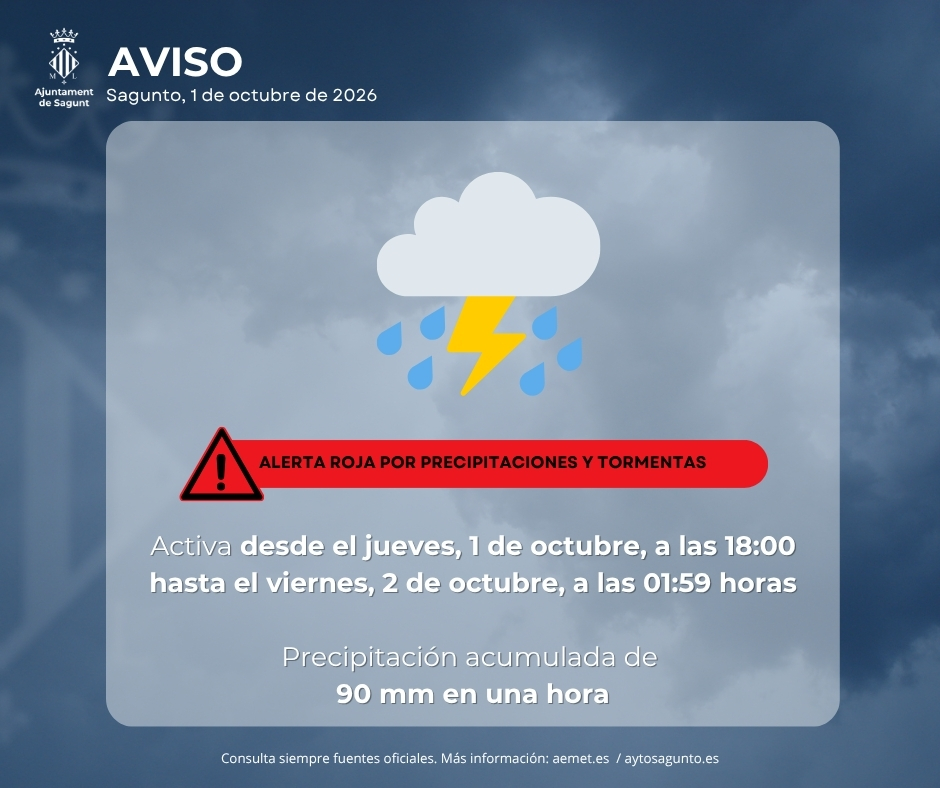
The regional 112 emergency service and AEMET (Spain's national weather agency) raised the alert to red level for rain and storms on the northern coast of Valencia province, and Sagunto cancelled classes, the council plenary and its markets until Friday.
The episode began this afternoon with a first orange stretch, active from 2pm, which moved up to the red level, the highest on the scale, at 6pm. That red stretch will stay active until 1:59am, and from then until 11:59am on Friday, 2 October, the alert will drop back to orange. Weather services expect storms with possible hail and very strong wind gusts, along with rain that could reach up to 90 litres per square metre in just one hour and 180 litres in twelve hours.
The difference between the two colours is more than just a label. According to AEMET itself, a red alert means extraordinary danger, with possible very serious or catastrophic impacts on vulnerable people, property, or exposed areas. An orange alert means important danger, with impacts that could be serious but not catastrophic. That scale is why Sagunto City Council activated the strictest level of its emergency protocol.
Among the steps taken in the municipality are the cancellation of this afternoon's classes, the halt of planned social, cultural and sports activities, and the closure of parks and public spaces from 5pm. The council also decided, as a precaution, to postpone the ordinary plenary session set for this afternoon, and stalls at the municipal markets, both in Sagunto and in Puerto de Sagunto (the coastal district), will not open on Friday, 2 October, either, so regular weekly shoppers will have to wait until the following week.
The alert is coordinated by the 112 Comunitat Valenciana service, a public emergency service run by the regional government that takes emergency calls and coordinates responders (health workers, firefighters, police and civil protection) during episodes like this one.
The strictness of these protocols on the northern coast of Valencia province, where Sagunto sits, has a direct precedent. The DANA storm of 29 October 2024 (a severe weather event that caused deadly flooding) killed at least 240 people officially across Spain, 230 of them in Valencia province, and councils in the area have applied preventive suspensions more strictly ever since any red alert is issued.
This is not the first time Sagunto has activated this kind of response. According to the City Council's own statement from September 2025, the CECOPAL (the municipal emergency coordination centre) met on a Sunday afternoon to prepare for different adverse scenarios ahead of a red alert expected the following Monday, with measures that then included suspending classes, cutting off flood-prone roads and recommending remote work.
Two months later, in December 2025, another red alert triggered a similar response in the city. According to the council at the time, forecasts pointed to up to 180mm of rain in twelve hours and more than 250mm over the whole episode, and the alert stayed active from midday on Sunday, 14 December, until 5:59am on Monday, 15 December, with all municipal activities planned for the Sunday suspended.
This Thursday's episode is not limited to the northern coast of Valencia. According to El Debate (a Spanish newspaper), the AROME forecast model, which had correctly predicted the worst-hit area and rainfall amounts during the October 2024 DANA, expected downpours of nearly 400 litres in towns in Castellón province such as Vilavella, Vall d'Alba and Canet lo Roig, within a red alert that covered five zones across Valencia and Castellón and 234 municipalities in total.
Sagunto City Council is asking residents to take extra care and follow official updates from the council, AEMET and the 112 CV service at 112cv.gva.es/es/alertas-poblacion. Advice includes not taking the car unless strictly necessary; if you must drive, stick to main roads or motorways, slow down and leave more distance from other vehicles, and stop if visibility gets worse. Residents are also urged not to go near or cross ravines, dry riverbeds or stretches of rivers where water can build up, and not to park in those spots. It is also worth securing awnings and blinds, checking that drains are not blocked, and putting away or tying down anything that wind or water could sweep off.
According to Sagunto City Council, with additional data from AEMET, 112 Comunitat Valenciana, Wikipedia and El Debate.