Sagunto holds minute of silence for gender violence killings in Alicante, Seville and Malaga
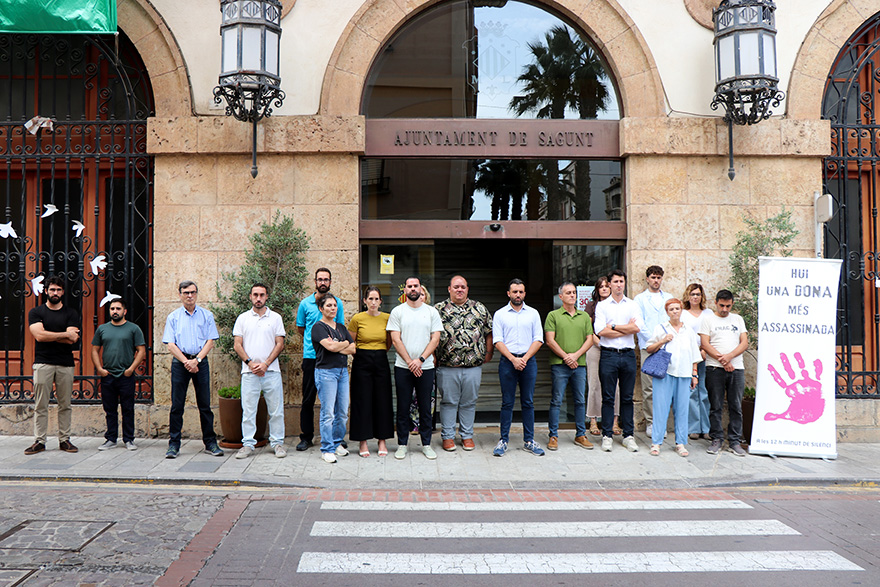
Sagunto City Council held a minute of silence this Thursday for three women, aged 33, 47 and 39, allegedly killed in gender violence cases in Alicante, Seville and Malaga.
Three women, aged 33, 47 and 39, were allegedly killed by their partners or former partners in Alicante, Seville and Malaga. In response, the Equality Department of Sagunto City Council called a silent gathering outside municipal buildings this Thursday, 1 October, at midday. Representatives of every group on the Corporación Municipal (the city's full council, made up of the mayor and elected councillors from every party), council staff, local residents, and several community groups and associations joined in.
The national toll cited in the statement gets harder to read the further back it goes: 41 women killed so far in 2026, a figure already close to the 47 recorded when 2025 ended. The running total since 2003, when official records began, stands at 1,382 gender-based killings nationwide. That figure also includes 68 children killed since 2013 and three cases this year of vicarious violence, a form of abuse in which the attacker kills a victim's children to cause her maximum harm. Spain's Government Delegation against Gender Violence (a national monitoring body), in its own records, independently confirms both the 1,382 total and the 68 child victims, matching the figures used by the council.
Sagunto held a similar minute of silence on 6 July, according to the City Council's own statement at the time, when the cumulative count since 2003 stood at 1,368 killings and the year's tally was 27 women. In under three months, both figures have risen by 14 cases each, a pace that reflects how persistent gender violence has been through 2026 and explains why the council is repeating this kind of act of condemnation more and more often.
Spain's Ministry of Equality, which confirmed the cases named in the statement, said the Seville case involved a 47-year-old woman allegedly killed by her 66-year-old partner on 26 September, and the Alicante case involved a 33-year-old woman allegedly killed by her 40-year-old partner the following day, 27 September. After both cases were confirmed, the national count stood at 40 women killed so far this year, a figure the later Malaga case raised to the 41 cited in Sagunto council's statement.
The institutional response, from the minute of silence to victim support protocols, rests on Spain's Organic Law 1/2004 of 28 December on Comprehensive Protection Measures against Gender Violence (Ley Orgánica 1/2004), which set the legal basis for the support services the council now recalls, and which, in 2026, has been in force for more than two decades.
Anyone who suspects a case of abuse has, as the council's Equality Department points out, a civic duty to report it through one of two numbers: the 016 helpline or the 112 emergency line. The 016 line offers free legal advice from 8am to 10pm every day of the week, in 53 languages, with a service adapted for people with disabilities, according to Spain's Ministry of Equality. Neither call shows up on the phone bill, though it is worth deleting the number from the phone's call log as a precaution.
Anyone who prefers a face-to-face approach can go to the Women's Support Service, run by the Equality Department: it offers in-person appointments on weekdays, from 8am to 3pm, and takes calls on 96 265 58 89, WhatsApp messages on 607 248 363, or emails to [email protected]. Booking ahead is the norm, though the team does not turn away anyone who arrives without an appointment when the situation is urgent. For a serious emergency, the number is 112, the Emergency Coordination Centre; but if an assault is already happening and immediate protection is needed, there are three forces to call depending on the case: the National Police (091 or 96 267 00 91), the Local Police (092 or 96 265 54 84), and the Civil Guard (Spain's gendarmerie, a military-status police force that also covers rural areas) on 062. There is also a regional option, the Centre Dona 24 Hores run by the Generalitat Valenciana (the regional government), reachable on 900 580 888 or, again, on 016.
According to Sagunto City Council and elperiodic.com, with additional data from Spain's Ministry of Equality and the Government Delegation against Gender Violence.