Sagunto honours 14-year-old European and Spanish wushu champion Ángel García
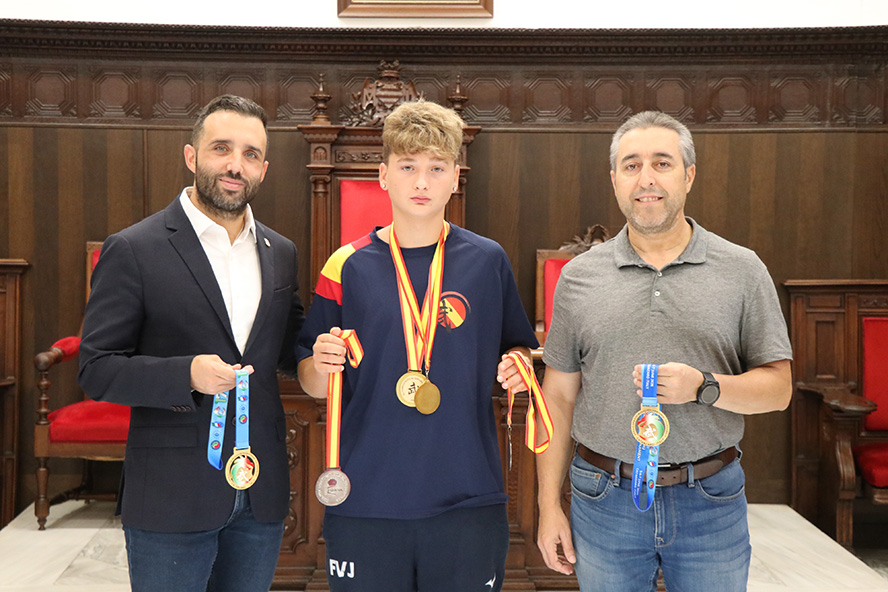
Sagunto City Council honoured 14-year-old athlete Ángel García this Wednesday, after he became double European wushu champion in Italy and Spanish champion in several categories this season.
At just 14, Ángel García de la Galana already holds two European titles and several Spanish championships in wushu, a record Sagunto City Council chose to honour this Wednesday with a ceremony in the plenary hall. The reception, organised by the Physical Activity, Health and Sports Department, was attended by mayor Darío Moreno, councillor Javier Timón, and the young athlete's family.
The most recent gold came in June, in Italy, where García won two continental medals, in Taolu empty-hand and long weapon, becoming double European champion. That same month, at the Spanish Traditional Championship in Vinaròs, he had already added another gold in long weapon and a bronze in a different event. He set the season's first step in March, in Madrid, at the Spanish Modern Championship, with gold in Taolu empty-hand and silver in short weapon.
Taolu, the discipline behind all his medals, is one of several Chinese martial arts styles grouped under wushu: it involves performing sequences of movements and acrobatics that judges score against difficulty and precision rules, according to Wikipedia, closer to technical gymnastics than hand-to-hand combat. Each routine is scored on a scale of up to ten points, and small details such as steadiness of balance or the cleanness of a jump can decide a medal, which is why competitors put in thousands of hours of technical repetition before ever stepping onto the competition mat.
Trained at Club Deportivo Wushu Náquera since he was 3, García had already reached the regional podium and the Spanish runner-up spot in Pamplona in 2022. Sagunto first received him a year later, in 2023, after a Spanish runner-up finish in Traditional Wushu in Villarreal; this Wednesday's tribute repeats the gesture with a far bigger medal record. Combining the technically demanding training wushu requires with a school timetable usually depends heavily on family support, an effort this Wednesday's ceremony was also meant to acknowledge.
It is not an isolated case in the city: last August the Council already honoured another Sagunto wushu athlete, Yago Gómez, for his silver at the National Traditional Wushu Championship, meaning Sagunto has handed out two recognitions to young athletes in this discipline within just a few weeks.
Councillor Javier Timón summed up García's leap in one line: he is no longer a promise but a real reference for local sport, and he highlighted the team behind the athlete at every training session and competition. Mayor Darío Moreno, for his part, linked the European success to years of discipline and sacrifice, beyond talent alone, in a sport that remains a minority pursuit. García closed the event by thanking his family, coach and friends for their support.
García's case also highlights a broader pattern that goes beyond wushu itself: alongside the big football and basketball headlines, Sagunto is home to several martial arts and combat sports clubs that rarely make the front page but compete regularly in national and international championships, usually with far smaller budgets and far less public attention than the mainstream disciplines enjoy. For those disciplines, institutional backing, even in the form of a formal ceremony like this Wednesday's, is often the only public recognition their athletes receive all season.
Wushu rarely takes centre stage in Sagunto sport, overshadowed by the bigger crowds football and basketball draw on weekends, but athletes like García are already adding international medals to the city's record. According to Sagunto City Council, with additional data from Wikipedia on wushu.