Antonio Atanasio Rincón wins Sagunto's 47th Autumn Photography Exhibition
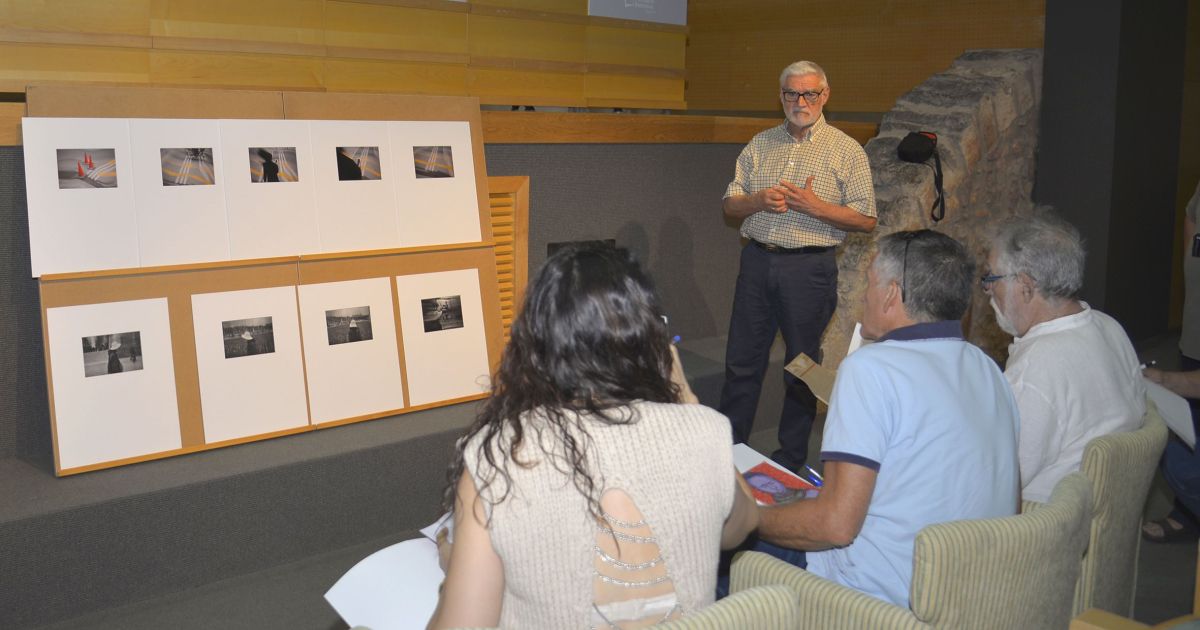
The photographer from Ciudad Real takes home the 900-euro first prize with his collection 'Mundo rural' (Rural World), one of 39 entries submitted by 24 photographers this year.
Sagunto now knows who takes the top prizes in its longest-running photography contest. In the 47th edition of the Autumn Photography Exhibition, organised by the Fundación Bancaja's local committee in the city, the jury handed out three main awards: 900 euros to Antonio Atanasio Rincón, who travelled from Villarrubia de los Ojos (Ciudad Real province) with his series Mundo rural (Rural World); 450 euros to José María Rubio Calonge, from Almassora, for Death Valley; and 300 euros to Sonia Rubert Martínez, from Vila-real, for Ritus y memoria (Rites and Memory). The three titles alone point to very different worlds: the rural Manchegan folk scenes evoked by Mundo rural, the American desert starkness suggested by Death Valley, and the introspection hinted at by Ritus y memoria — a variety the jury seems to have rewarded as much as the technical quality of each series.
Alongside those three general prizes, the contest sets aside a category of its own for members of ARSE de Sagunt, the city's local photography group. This year its two community prizes went to Pedro Díaz Hermoso, for his image Peter II, and Begoña Cosín Moya, for Farolas. The group's name is not random: it recalls the Iberian settlement of Arse, the pre-Roman village on the hill where Sagunto Castle now stands, which eventually grew into the Roman city of Saguntum. The overlap is not just etymological: keeping a dedicated social-category award, separate from the three general prizes, is the contest's way of recognising ARSE as a benchmark of local photographic practice, distinct from the competition among entrants from other provinces.
This year's call for entries drew 24 photographers, who submitted 39 collections to the general category, while the community category brought in 16 photographers and 28 images. Nearly half a century after its first edition, those numbers keep the Autumn Exhibition among the best-established events on Sagunto's cultural calendar. Turnout, steady compared with recent editions, confirms the appeal of a contest that mixes photographers arriving from further afield with entrants from Camp de Morvedre itself, a district where documentary and fine-art photography have a solid tradition thanks to groups such as ARSE. That turnout has held steady at a time when photography contests and social media compete for attention says a good deal about the loyalty the event inspires among the district's amateur photographers.
Anyone wanting to see the winning entries will get the chance, alongside a selection of other submissions, at the exhibition organised by the Fundación Bancaja: it opens on 24 September at Casa Capellà Pallarés in Sagunto and can be visited until 16 October. Anyone who cannot make the opening will have three weeks to visit the show, which will bring together not just the five winning works but a wider selection drawn from the 39 general-category collections and the 28 photographs in the social category.
Belén Genovés Casquete, head of the Fundación Bancaja's local committee in Sagunto, chaired this year's jury, which also included Gerardo Balbás Regidor, Susana Castillo Cabel, Manuel Marzal Felici and David Jairo Pérez Remiro. Behind the organising body lies a long history: Fundación Bancaja traces its roots to a savings bank (Caja de Ahorros y Monte de Piedad) set up in 1878 by the Real Sociedad Económica de Amigos del País de Valencia (Valencia's Royal Economic Society of Friends of the Country), the seed of what is today one of the Valencian Community's major cultural patrons. Its involvement in Sagunto, renewed year after year through this contest, adds to the work of other local entities and collectives that keep photography alive in the district beyond this one annual event.
For the city, the Exhibition also works as an annual showcase for amateur and professional photography, drawing entrants from Camp de Morvedre as well as other Spanish districts and provinces. Mixing established names with local amateurs grouped in collectives such as ARSE, the contest reinforces Sagunto's role as host of an event with more than four decades of history on the district's cultural calendar. According to El Periódico de Aquí, with additional background from Wikipedia on Fundación Bancaja and the origin of the ARSE name.