Faura restores its landmark hackberry tree, linked to the village's memory
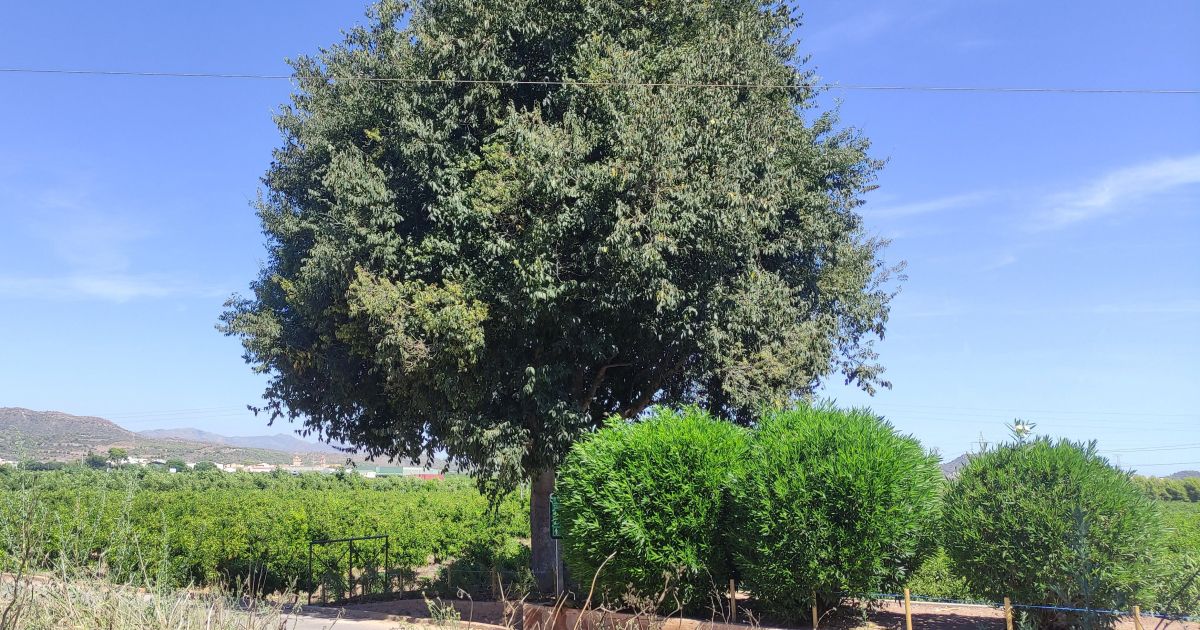
In Faura, a Camp de Morvedre town next to Sagunto, the local council has completed the restoration of its landmark hackberry tree, a century-old specimen tied to the memory of several generations.
Faura has restored one of the plants most closely tied to its landscape. The town, located in the Camp de Morvedre district next to Sagunto, has completed work to restore and showcase its landmark "lledoner" (hackberry tree, Celtis australis), which grew naturally beside the local irrigation channel and ravine and has, over the years, become part of the area and the memory of several generations of residents.
The work improved the tree's conservation and safety and upgraded the surrounding space. It included building a new reinforced-concrete wall to replace the old perimeter wall, which was badly deteriorated with several collapsed sections. Part of the immediate surroundings was also renewed: myrtle shrubs were planted on the side facing the irrigation channel to mark the boundary and create a natural transition, while the ground was covered with vegetal bark mulch for a more natural finish and easier upkeep.
Faura's mayor, Consol Duran, said some trees are far more than trees: they are part of the landscape, of memories and of the images people associate with home, noting that this tree has stood for generations as part of the town's identity. The project had a budget of 15,480.99 euros, fully funded by the Valencia Provincial Council (Diputación de Valencia) through its 2022-2023 Investment Plan, and forms part of the town's long-term Tree and Green Space Master Plan.
The restored tree belongs to a notably long-lived species: the hackberry can live up to 600 years and grow 20 to 25 metres tall, giving real scale to the generational bond the mayor describes. It also naturally grows in ravines, hillsides and riverbanks, exactly the kind of setting where Faura's tree has developed beside the irrigation channel, meaning its location is not accidental but typical of the species' natural habitat.
At the same time, the council is studying further action on the town's trees. One is planned for Plaça Major, where an existing palm tree has failed to survive the red palm weevil despite years of treatment, so officials are now assessing options to replace it. Another study covers Plaça de la Glorieta and the adjoining street and pavement, where tree roots have damaged the paving and some trees are in poor enough condition to require comprehensive action.
Faura is one of the smallest towns in the Camp de Morvedre district, with just a few thousand residents, and its municipal boundary borders Sagunto, whose town centre is only a few minutes away by road. That proximity explains why many local residents work, study or shop in the district's main town, even though Faura keeps a strong identity of its own, shaped by traditional irrigated farmland, market gardens and the network of irrigation channels and ravines where the restored hackberry tree has grown. Preserving specimens like this one is part of a wider effort by the district's smaller towns to protect natural heritage that, unlike major monuments, rarely has enough resources of its own for upkeep and depends heavily on cross-municipal programmes such as the Valencia Provincial Council's Investment Plan.
Interest in preserving standout trees is not unique to Faura: the Provincial Council keeps its own catalogue of monumental trees across the province, including century-old specimens of great landscape and sentimental value, comparable in social role to Sagunto's Olivera de Gausa, an olive tree more than 350 years old that plays a similar part as a symbol of local identity. In both cases, the case for public investment is not just botanical but social: these are trees that have accompanied the growth of several generations and, once lost, cannot simply be replaced by a young specimen without the town losing part of its collective memory. That same logic explains why Faura Council has chosen to pair the hackberry's restoration with a Tree and Green Space Master Plan applying similar criteria to the rest of the town's trees and green spaces, rather than limiting itself to a one-off intervention on a single specimen.
Faura Council has said the hackberry's condition will now be included in the council's regular tree inspections, to catch any future conservation issues early.
The finished site will remain freely open to visit, since the area around the hackberry stays public land accessible to any Faura resident.
The mayor said the goal is to combine protecting trees tied to the town's history with planning green spaces for the future. According to El Periódico de Aquí, with additional background from Wikipedia on the Celtis australis species.