Sagunto's Roman Theatre takes centre stage at Spain's National Archaeological Museum
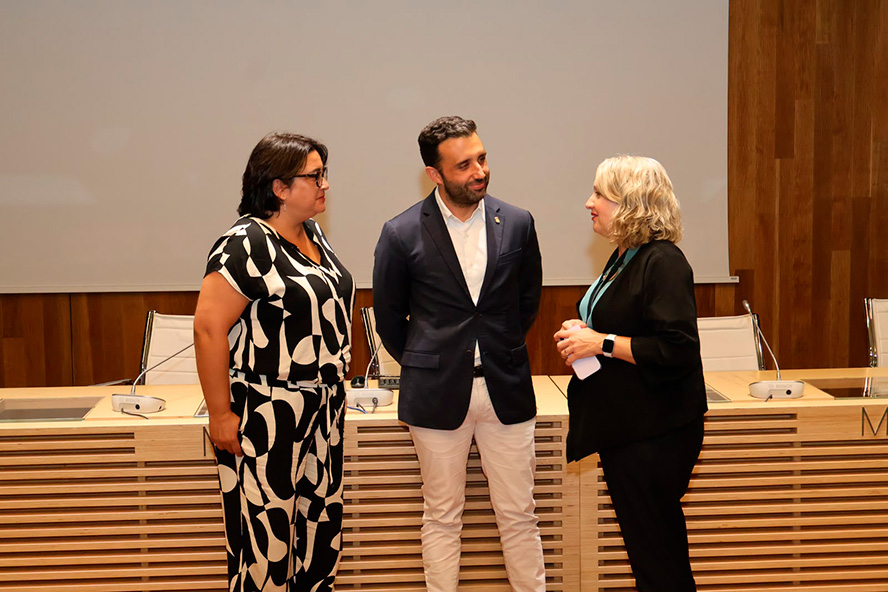
Archaeologist Carmen Aranegui explained the ancient theatre's urban role in Madrid on Tuesday, in the year marking 130 years since it was declared a National Monument.
With 130 years of official protection behind it, Sagunto's Roman Theatre has once again travelled outside the city to talk about itself. It did so on Tuesday in Madrid, in the auditorium of the National Archaeological Museum (MAN), where Carmen Aranegui Gascó, professor emerita of Archaeology at the University of Valencia, gave the talk "El teatro romano como icono político urbano: Saguntum" ("The Roman theatre as a political urban icon: Saguntum"). It was introduced by the museum's director, Isabel Izquierdo Peraile, as part of the activities linked to the exhibition From Greek Tragedy to Roman Comedy: Classical Theatre, on show in the museum's Vitrina CERO space.
Aranegui focused her talk on how the building fitted into the layout of Roman Saguntum. She explained that, because the ancient city was built in terraces up the hillside, the theatre worked as a hinge between the forum below and the neighbourhoods climbing the slope. Visible from the roads leading into the city, its sheer size helped shape the landscape and, the researcher argued, reinforced the civic character of the ancient city — a role that, in a different way, the monument still plays in Sagunto's image today.
The event was attended by a council delegation on a direct invitation from MAN itself, an institution run by Spain's Ministry of Culture: leading the group were Mayor Darío Moreno, the councillor for Cultural Heritage and Tourism, Natalia Antonino, and municipal heritage staff. The council reads the invitation as recognition of the interest the Sagunto site generates among Spain's leading cultural institutions.
Vitrina CERO, open until 18 October, does more than display objects: it draws on books and museum items from MAN's own collection to trace how classical theatre moved from Greek tragedy to Roman comedy, treating ancient stages not just as places of spectacle but as vehicles for ideas and as tools of political and social power. That is precisely the angle Aranegui applied to the specific case of Saguntum.
The timing is no coincidence. In 2026, 130 years have passed since the theatre was declared a National Monument on 26 August 1896, one of the earliest heritage protections in the current Spanish system. That declaration, however, came many centuries after construction began: the building's design already dates to the time of Emperor Augustus, though the work was not finished until the reign of Tiberius, in the early 1st century AD.
Between that date and today, the monument also went through a much more recent and thorny chapter. In the 1990s, architects Giorgio Grassi and Manuel Portaceli carried out a restoration that added a modern set of seating and a stage on top of the surviving Roman stonework. From day one, critics argued this amounted to building a new theatre over the old one — a debate still cited as a reference case in Spanish archaeological heritage management. That controversy still colours how Sagunto approaches the site today: any future intervention on the Roman theatre has to reckon with the same tension Grassi and Portaceli faced three decades ago, between keeping a working, visitable monument and preserving the very stonework that earned it national protection back in 1896. Tuesday's lecture, built entirely around the building's original urban role rather than its modern additions, gave the council a chance to put that authenticity back in the foreground.
Sagunto City Council uses occasions like this to build ties with influential institutions and fold them into its drive to research, care for and promote the city's legacy. Taking the Roman theatre — and the Saguntum it represents — to venues such as MAN fits the council's strategy of turning the site into a leading tourist and cultural attraction, at a time when Sagunto is trying to combine that classical past with its industrial push into clean energy. Being invited by an institution of MAN's standing is no mere formality for the council: it signals that Sagunto's heritage draws attention beyond the region and strengthens the city's hand in balancing preservation with tourism and cultural strategy. According to Sagunto City Council, with additional background from Wikipedia on the theatre's construction timeline and restoration.