Benicalaf church begins new phase to restore its former splendour
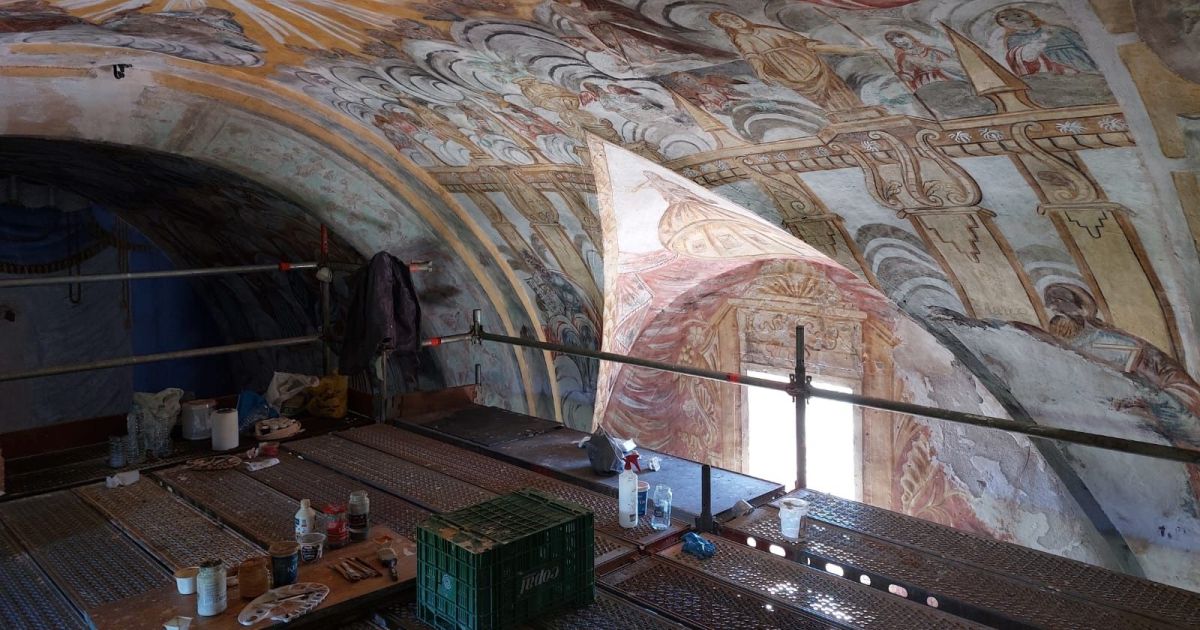
In Benavites, a Camp de Morvedre town near Sagunto, work has begun to restore the second section of the nave and the side chapels of Benicalaf church, the only standing remnant of a vanished medieval village.
Benicalaf church, in the municipal area of Benavites, a Camp de Morvedre town near Sagunto, continues its long restoration process with a new intervention focused on conserving its decorative elements. According to municipal sources, the Generalitat Valenciana (Valencian regional government) and Benavites Council have launched a second phase of works, with an investment close to 50,000 euros and an estimated completion time of two months.
The project will allow further work on the interior of the church, following interventions carried out in recent years. This phase will focus on the second section of the nave and the side chapels, continuing on from a first phase that already restored the initial part of the interior. The plan includes specialised cleaning of the wall surfaces to remove dirt and built-up material without damaging the original coatings, as well as removing old cement mortars and stuccoes from previous repairs that are now stuck to the historic surfaces.
One of the main goals is to recover the historic decoration on the walls. Specialists will work on the different decorative layers already studied and documented, paying particular attention to the sgraffito decorations that form part of the temple's original design, dating mainly from the last third of the 17th century. Where these have disappeared, the project envisages reconstructing the design based on the marks and traces still visible on the surface.
The church is dedicated to Saint James the Apostle, and documentary references place a place of worship on this site as early as 1469, though the current building is the result of various later transformations, particularly during the 17th century. Benicalaf was in fact an independent municipality until 14 April 1856, when it was annexed to Benavites; today only the church remains standing, the sole trace of the old settlement, which explains why the temple now stands isolated in open countryside within the municipal area.
Restoring the church is not a one-off project but a phased process, given the building's state of conservation. In 2017, emergency work reinforced the structure and addressed the main facade and roof. Work later moved to the presbytery and, since 2022, action has progressively shifted to the interior of the nave. Over the years the building has suffered from a lack of maintenance, weather exposure and several incidents of vandalism, with damp as one of the main problems, affecting the wall paintings and supporting materials due to water infiltration, alongside vibrations from the building itself that have caused cracks, fissures and loss of cohesion between layers of coating.
The Benicalaf restoration is one of several heritage projects moving forward in parallel across different towns in the Camp de Morvedre district, largely funded by the Valencia Provincial Council and the Generalitat Valenciana, in a district where Roman-era remains, like those in Sagunto itself, sit alongside medieval and later religious buildings scattered across much smaller towns like Benavites. Benicalaf's uniqueness lies precisely in being the only standing trace of a municipality that ceased to exist as an administrative entity more than a century and a half ago, which makes any work on the building especially delicate: it is not simply about restoring a church, but about preserving the only physical proof that settlement ever existed independently.
This kind of phased restoration, stretched over years because of the limited scope of each budget allocation, is common for religious heritage in small towns, which rarely have enough resources of their own to carry out a full restoration in one go. Cooperation between administrations -in this case, Benavites Council and the Generalitat Valenciana- is therefore key to completing projects like Benicalaf, even if that means spreading the work across successive phases over several years, as has happened with the 2017 works, the presbytery restoration, and now the second section of the nave.
Benavites Council has said that once this second phase is finished, it will assess together with the Generalitat Valenciana the timeline for the further work needed to complete the church's full restoration, though no firm date has yet been set.
Access to the inside of the church will remain restricted for as long as the works last, for safety reasons.
Previous work has notably improved the situation, including structural consolidation, the recovery of baroque wall paintings and sgraffito in the presbytery, and work on various facades, though full restoration of the complex still requires further action. According to El Periódico de Aquí, with additional background from Wikipedia on the former municipality of Benicalaf.