Sagunto council approves declaration of solidarity with Colombia after earthquake
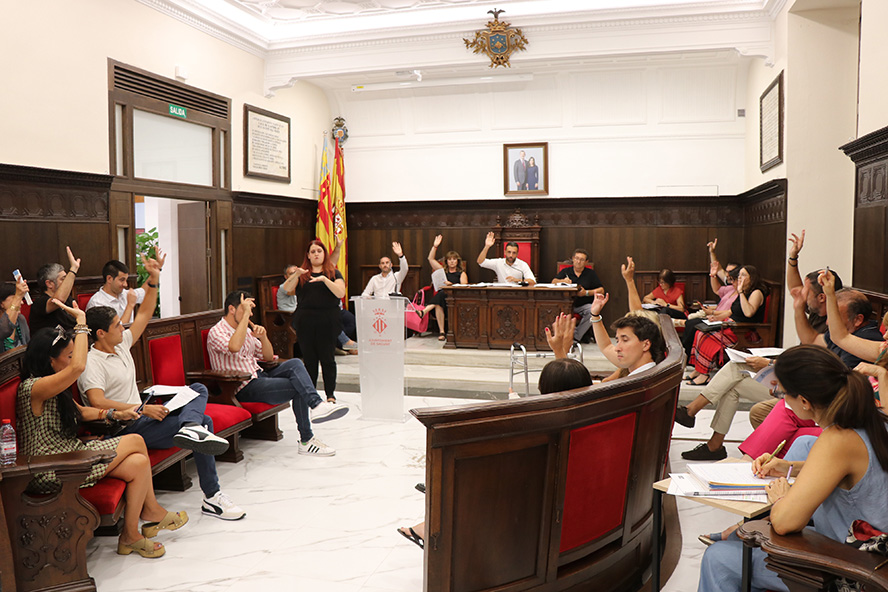
Sagunto's city council unanimously approved a declaration of solidarity with Colombia after the 10 August earthquake, which has left 329 dead and affects the roughly 3,200 Colombians living in the city.
Every political group on Sagunto's council — from the ruling team to the opposition — backed the same text on Thursday: an institutional declaration expressing the town's support for the people of Colombia, hit by the earthquake of 10 August. The move, the document itself explains, comes from a council that sees cooperation between peoples as a concrete form of solidarity, and it arrives weeks after the South American country began tallying its losses. In practice, this is a symbolic gesture: it sets aside no specific budget, but it does send a political message to a community with a strong presence in the city, acknowledging the work of everyone sustaining the disaster response, from emergency services to individual volunteers. The fact that the proposal went through with the unanimous backing of every group, not just the ruling team, underlines the cross-party nature of the gesture: no group, not even those in opposition, wanted to stay on the sidelines of a message of support for a community with such a visible presence in the city.
It's worth setting the earthquake in context: it struck on 10 August, measuring magnitude 7.4, with its epicentre near San José del Palmar (Chocó), at a depth of 103 km. That is a small town — just 5,809 people, according to 2025 population estimates — which shows how rural the quake's ground zero is, even though its impact reached a much wider area: fifteen departments and more than 450 municipalities, with Caldas, Chocó, Risaralda, Quindío and Valle del Cauca among the hardest hit. Three of those — Caldas, Risaralda and Quindío — sit within Colombia's Coffee Axis (Eje Cafetero), while Chocó and Valle del Cauca face the Pacific, a stretch of difficult terrain that has slowed rescue efforts. The gap between the size of the town where the epicentre sat and the scale of the area eventually affected — fifteen departments, hundreds of municipalities — gives a sense of just how far-reaching a quake that began at one small, rural point of the country turned out to be.
The human and material cost of the quake, updated to 22 August, comes down to three figures: 329 dead, 4,600 injured and 247 unaccounted for. Added to that is the housing toll tracked by Colombia's National Disaster Risk Management Unit: around 171,000 homes with some degree of damage, more than 31,000 flattened outright, 553 buildings brought down and another 5,700 left with structural cracks that must be checked before anyone can live in them again. Twelve days after the quake, these figures were still being updated as emergency teams reached the most isolated areas of Chocó and Valle del Cauca, the regions hit hardest by communication cuts and difficult terrain.
Beyond the figures, Sagunto's declaration dwells on what those numbers hide: families no longer whole, houses that no longer exist, and entire towns that will need years to rebuild. The council directs its condolences, first and foremost, to the people living through that grief up close, with an explicit nod to the Colombian community based in the municipality itself.
That nod is no coincidence: Colombians and Spaniards share a language and a history, and Spain's National Statistics Institute (INE) counts 978,041 Colombian-born people currently living in Spain. Around 3,200 of them live in Sagunto, a town where close to 17% of residents were born abroad, mostly in Latin America and North Africa. That demographic weight, the declaration says, is why the pain of these days is also felt in Sagunto's own neighbourhoods, where the Colombian community has spent years becoming part of the town's social, working and associative fabric.
The council's decision joins the wave of condolences that has swept across Spain in recent weeks, through which Sagunto hopes to do its part so that aid reaches those who need it most in an orderly way. Since this is an institutional declaration rather than a direct aid package, as the approved text itself makes clear, its practical reach will ultimately depend on other administrations and humanitarian organisations channelling economic cooperation, while the council formalises in writing a support that the declaration itself frames as an act of cooperation between peoples. Source: Sagunto City Council, with additional background from Wikipedia on the 2026 Colombia earthquake.