Germans Caballer of Sagunto win the 2026 Forcat Award for traditional music
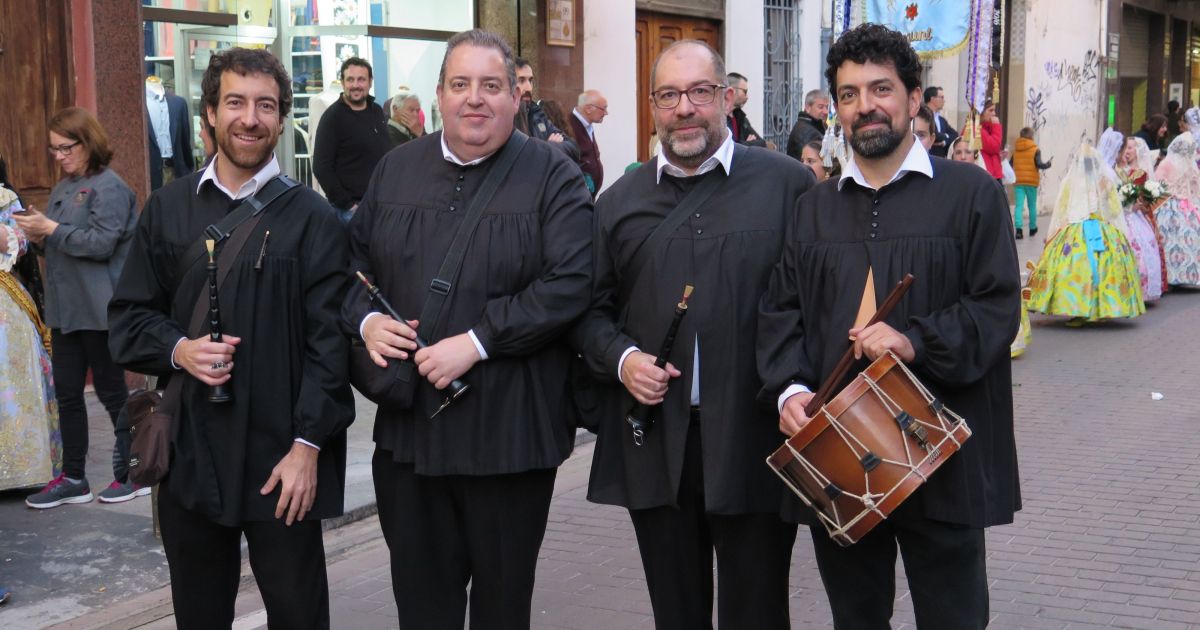
The Caballer brothers, folk musicians from Sagunto playing since 1981, will receive the 22nd Forcat Award in Valencia this Saturday for their work preserving traditional Valencian music and dance.
Traditional music from Sagunto takes centre stage in Valencia this Saturday, when the group Germans Caballer will receive the 22nd Forcat Award 2026. The prize is given every year by Grup de Danses El Forcat (a Valencian folk-dance association) to people and groups who work to preserve, promote and spread Valencian folklore, in music, dance and traditional costume. The award ceremony will take place on Saturday, 3 October, at 17:30, in the Alfons el Magnànim hall of the La Beneficència cultural centre in Valencia.
The award-winning group is made up of four brothers: Paco, Eduard, Xema and David Caballer. They taught themselves to play the dolçaina (a traditional Valencian woodwind instrument, similar to an oboe) and the tabal (a traditional drum) around 1981, with no formal training. That shared learning later led to the founding of the association Amics de la Música Tradicional - Dolçainers de Sagunt, which has supported much of the group's musical and teaching activity in the city ever since. In 2021, marking their first 40 years together, the group celebrated with a public concert in the courtyard of Sagunto's Mercado Municipal (municipal market).
The Caballer brothers' influence goes beyond performing. Since 2011, the group has organised an annual gathering called FolkaSagunt, where the brothers and members of their association perform together. Now in its second decade, the event has become a fixture on Sagunto's festive calendar for fans of the dolçaina and tabal, and shows another side of the group: organising and bringing together other traditional musicians.
The Forcat Award itself has its own history. It is given by Grup de Danses El Forcat, founded in Valencia in November 1992 by Vicente Garijo Hernández with the sole aim of studying, researching and promoting traditional Valencian costume, dance and music. More than three decades later, the group still pursues that founding goal through an annual award that reaches its 22nd edition in 2026, now considered one of the leading recognitions for folklore in the Valencian Community.
This is not the first time the Caballer brothers' career has been recognised. In 2010 they won the Onda Cero Culture Award; in 2013, the Falla Santa Anna (a local festival committee) named them Saguntí de l'any (person of the year); in 2015 they received the Arrels Award from the Associació Arrels d'Estivella; in 2016 the outlet Periòdic d'Ací gave them the Tradicions Award, and in 2021 they received a Premi Jaume I from the town of Canet d'En Berenguer. Five awards in just over a decade, now joined by the 2026 Forcat Award, show an unusually consistent track record for a local traditional-music group.
The award has its own recent history too. According to letno.dival.es, the cultural portal of the Valencia Provincial Council, in October 2024 the previous edition of the Forcat Award recognised Isabel Martí Chulià, of the Grup de Danses Portetxol in Jávea, for her work recovering traditions from towns in the Marina region. Two years later, the jury has turned its attention to Camp de Morvedre, rewarding more than four decades of work by a group that started out self-taught in a Sagunto courtyard.
For the Germans Caballer, the recognition comes as the dolçaina and tabal continue to accompany processions, official events and popular celebrations in Sagunto throughout the year, from patron-saint festivals to school events promoting local folklore. The group has said it hopes the city will support them at the award ceremony, a day they consider especially meaningful after more than forty years playing the tabal and dolçaina.
According to El Periódico de Aquí. Additional information: Sagunto City Council, the Federació de Folklore de la Comunitat Valenciana (Valencian Folklore Federation) and the Germans Caballer official website.