Sagunto already has six public EV charging points active out of 21 planned
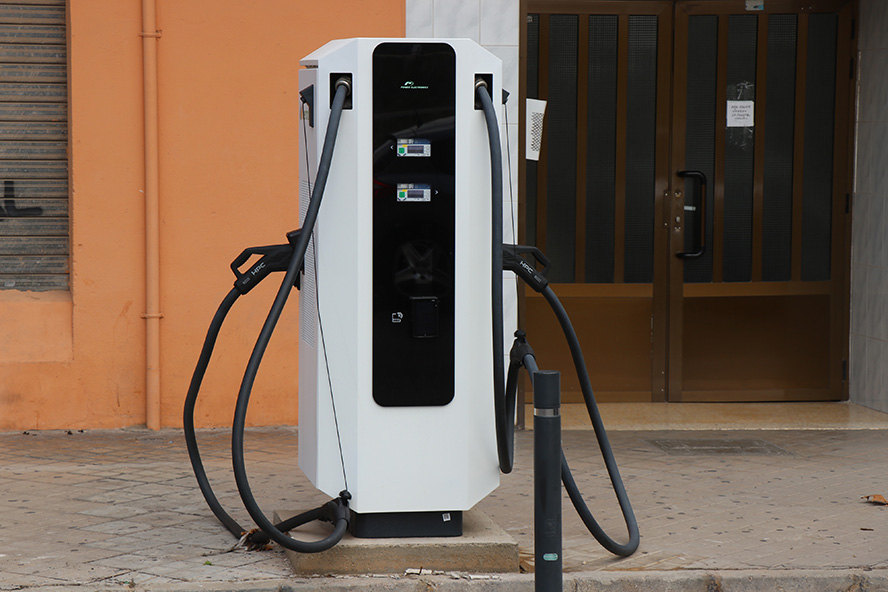
Sagunto City Council has switched on six of the 21 planned electric-vehicle charging stations across the municipality, meaning 14 of the 48 total charging spaces are already usable.
Sagunto City Council is continuing to build a municipal network of electric-vehicle (EV) charging points, a project that will eventually reach 21 stations and 48 charging spaces spread across the whole municipality. According to the council, six of those stations are already working, which means 14 of the final 48 spaces can already be used. Four more installations are finished and will start operating in the coming weeks, while eight more points are still under construction and three are still at the planning stage. In other words, roughly a third of the planned network is already up and running: 14 of the 48 total spaces.
The spaces already in use are grouped in six locations: the car park in front of the Pabellón Polideportivo Municipal (municipal sports hall), in the Internúcleos area, which has four spaces, plus five more points with two spaces each, on Avenida 3 de Abril (near number 50), Avenida 9 de Octubre (number 29), Calle Sierra de Irta (number 1), Calle Cánovas del Castillo (number 80) and Calle Isla Menorca (number 1). Anyone who wants to check in real time which stations are working and which are still under construction can use the interactive map the council has set up for this purpose, showing the exact location of all 21 planned stations.
The rest of the network will spread across another 14 points around the municipality, including busy spots such as the car park at Hospital de Sagunto, the one at Pabellón René Marigil (a sports hall), Plaza Cronista Chabret, Plaza Antigua Morería and the Ramón de la Sota roundabout, as well as Avenida Doctor Palos, Avenida Camp de Morvedre and the streets Ciprés, Dolores Ibárruri, Vicent Andrés Estellés and Muntanyars. The expansion will also reach the municipality's two industrial estates, with charging points at Plaza Torres Quevedo, inside the SEPES industrial estate, and on Avenida Ojos Negros, in the Ingruinsa industrial estate, plus the Nave de Efectos y Recambios, the industrial building that will one day house Sagunto's future Industrial Museum. Altogether, the chosen locations stretch from the old town area to Puerto de Sagunto (coastal district) and the industrial zones, so that once the project is finished, no neighbourhood should be left without a nearby charging point. Judging by the list of addresses, the new points will reach both dense residential areas and major public facilities, such as the hospital or the sports halls.
As usually happens with this kind of rollout, the council did not install all 21 stations at once. It prioritised the points with the highest expected use first — sports facilities and busy avenues — before finishing the rest of the network in industrial estates and more peripheral streets. That order explains why the working spaces are currently concentrated around Internúcleos and a few central avenues, while the points in the SEPES and Ingruinsa industrial estates, or at the future Industrial Museum site, are still under construction or still being planned.
The council's Environment Department, led by councillor Jorge Vidal, explains the investment as a response to one of the most common reasons people hesitate to buy an electric car: not having a private garage to plug it in, or no accessible charging point nearby. Vidal argues that the new municipal network aims to solve exactly that problem, so that an electric car stops being an option only for people with private parking and becomes a realistic choice for both the environment and the wider public.
The move fits with the wider shift Sagunto has been going through in recent years, moving away from near-total dependence on heavy steel industry towards becoming a Valencian reference point for electric mobility, with the future battery gigafactory from PowerCo (a Volkswagen Group subsidiary) as the most visible project of that change. A wide, well-distributed public charging network matters especially in a municipality where many residential buildings, particularly in older areas, do not have a private garage. That shortage of private parking, in a municipality where housing access is already a source of concern for many residents, means a well-distributed public network is, for many families, the most realistic way to charge an electric car without depending on a private garage.
The council has not yet given an exact date for when the eight stations currently under construction will start working, though it has confirmed the four already-installed ones will switch on soon. Until the network is complete, the council recommends that anyone already driving an electric car, or thinking about switching to one, check the municipal map before planning any trip that depends on finding a free charging point. According to Sagunto City Council, with additional information from elperiodic.com.