Sagunto holds minute of silence over suspected femicide in Madrid
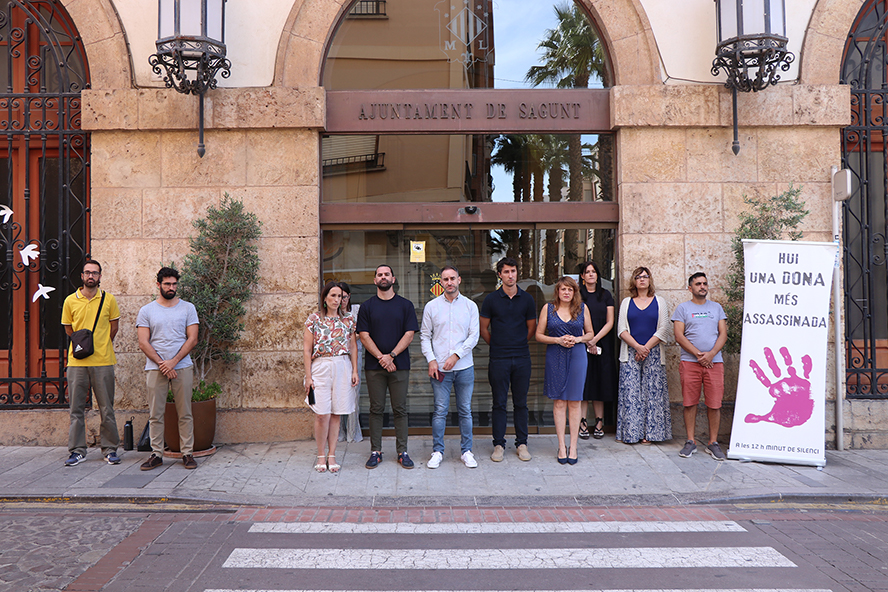
Sagunto's town hall held a minute of silence outside municipal buildings on Tuesday over the suspected gender-based murder of an 88-year-old woman in Madrid.
Thirty-seven women killed so far in 2026, forty-seven last year, and a running total that has kept climbing since 2003: 1,378 gender-based killings in Spain. Those were the figures Sagunto town hall's Equality Department put forward on Tuesday 15 September, when it called a minute of silence at 12:00 outside municipal buildings over the suspected gender-based murder of an 88-year-old woman in San Sebastián de los Reyes, in the Madrid region.
The fact that the gathering was called just hours after the incident became known, without waiting for any judicial confirmation of the case's details, reflects how the institutional response to gender-based violence has changed in recent years: town councils no longer wait for a case to be formally closed or confirmed by a court before taking a public stand, instead triggering the gesture of condemnation almost automatically as soon as the alarm is raised anywhere in the country.
The gathering, held outside the municipality's public buildings, brought together members of the town council, town hall staff, local residents and several community groups and associations, in a show of rejection that is repeated whenever a new case is confirmed or investigated anywhere in Spain.
The figures kept by the Equality Department are not limited to adult victims: 68 minors have been killed for the same reason since 2013, and 2026 alone has already seen three cases of so-called vicarious violence — the killing of children specifically to harm their mothers.
Alongside the minute of silence, the Equality Department used the moment to repeat a recurring message: anyone who suspects a case of gender-based violence has a civic duty to report it, either through the dedicated helpline 016 or the emergency number 112, both staffed around the clock. Calls to 016 do not show up on phone bills, though the department still recommends deleting them from the call log as a precaution.
For direct support in the municipality, the Equality Department's Women's Support Service takes appointments Monday to Friday, from 8:00 to 15:00, by phone (96 265 58 89) or WhatsApp (607 248 363), and also by email at [email protected]; in urgent cases, it also sees people without an appointment. Those channels sit alongside options for serious emergencies: 112 for the Emergency Coordination Centre, the National Police on 091 or 96 267 00 91, Sagunto's Local Police on 092 or 96 265 54 84, and the Civil Guard on 062, all intended for anyone who has suffered an assault and needs immediate protection. The Generalitat Valenciana's 24-hour Women's Centre, reachable on 900 580 888 or via 016, rounds out the network of resources the town hall offers victims.
The term vicarious violence itself, which the Equality Department uses when breaking down the figures, refers to a relatively recent category under Spanish law: it specifically targets anyone who uses children as a tool to cause the greatest possible harm to their mother, going a step further than abuse directed at her alone, and treating the harm done to the children as a deliberate extension of the violence against her.
Gatherings like Tuesday's have become part of how local institutions routinely respond to gender-based violence: they are not a reaction to something that happened in Sagunto, but the condemnation protocol the Equality Department triggers automatically whenever a new case makes national news — a reminder that the problem persists, and that support resources are available right in the municipality. That regular reminder also serves a less visible, practical purpose beyond the symbolic gesture: keeping the people who work alongside the town council up to date on who to call and where to go before a real emergency arrives. According to Sagunto town hall and elperiodic.com.