Sagunto recycles almost 40,000 kg more glass this summer season
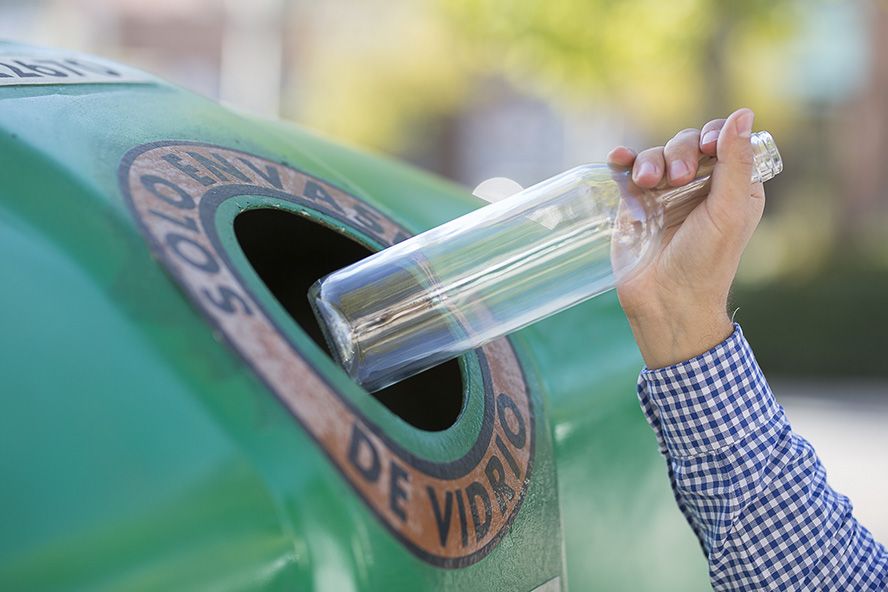
Sagunto collected 169,280 kg of glass packaging in July and August, with 135 bars and restaurants joining Ecovidrio's campaign for the Green Flag award.
Bars and restaurants in Sagunto became an unexpected recycling engine this summer: between July and August, 169,280 kg of glass packaging was recovered — almost 40,000 kg more than the same period in 2025, when the figure stood at 130,100 kg.
Growth was not even across the two months. August saw the sharpest jump, with 79,180 kg collected — 78% more than August 2025 — while July, affected by the SAG (waste collection) strike, grew more modestly, with 90,100 kg, 5% above the previous year.
August's rebound is especially notable next to July, a month affected by the SAG waste-collection strike, which likely made it harder for some businesses to properly sort and deposit glass packaging for several weeks. Once that setback passed, August's 78% jump suggests the campaign gained momentum among local hospitality businesses as peak season progressed.
Behind these figures lies the work of 135 hospitality businesses in Sagunto, which joined this year's seventh edition of the "Green Flags Movement", Ecovidrio's initiative to get the restaurant sector involved in recycling during peak tourist months. The focus makes sense: the organisation itself estimates that hospitality generates half of all the glass put into circulation during summer in coastal destinations. Regionally, the Green Flags Movement mobilised more than 13,300 hospitality businesses across Andalusia, Catalonia, the Valencian Community, the Balearic Islands and the Region of Murcia back in 2022, putting Sagunto's 135 participating venues within a much larger network of businesses committed to summer recycling.
Sagunto did not compete alone: 27 other municipalities in the Valencian Community took part in the same edition, all vying for the Green Flag for Sustainability, an award Ecovidrio grants based on three combined criteria — the percentage increase in tonnes collected, the share of hospitality businesses involved, and how well each town council promotes the campaign.
Placing the local figure in a wider frame helps explain its significance: nationally, Ecovidrio again surpassed one million tonnes of recovered glass in Spain in 2024 — 1,004,315 tonnes exactly — of which more than 90% came through the green container, the same system that grew strongly in Sagunto this summer.
The environmental case behind these campaigns rests on a concrete technical fact: making new glass from cullet (already crushed glass) requires a lower melting temperature than starting from virgin raw materials, which translates directly into lower energy use and lower CO2 emissions throughout the industrial process.
Once dropped into the green containers, glass collected in Sagunto follows the same route as in any other town signed up to the Ecovidrio system: it is transported to a treatment plant where impurities — caps, labels, bits of other materials — are removed before it is crushed into cullet, the raw material packaging factories then reuse to make new bottles and jars without needing virgin sand, soda ash and limestone. This closed loop, in which the same piece of glass can be recycled indefinitely without losing quality, is one of the reasons glass is considered one of the most efficient materials to recycle, unlike other packaging that can only go through a limited number of cycles before degrading.
For participating bars and restaurants, joining the campaign brings no direct financial reward — it is more a matter of image: Ecovidrio provides businesses with dedicated containers and promotional materials to showcase their participation to customers, in a sector where sustainability has become an increasingly valued selling point among tourists visiting the Sagunto coast in summer.
The underlying challenge, beyond the summer campaign, is turning glass separation into a year-round habit in local hospitality, rather than a one-off effort tied to the chance of winning the Green Flag. Such recognition, if achieved, would also add value to the town's tourism promotion, placing Sagunto among the Valencian coastal towns visibly committed to environmental sustainability.
For the council, this summer's results confirm an upward trend that has been building over recent years in a town with a strong hospitality sector, both in the historic centre and in Puerto de Sagunto. According to El Periódico de Aquí, with additional data from Ecovidrio via Wikipedia.