EUPV-IU backs route that keeps Sagunto-Teruel rail line intact
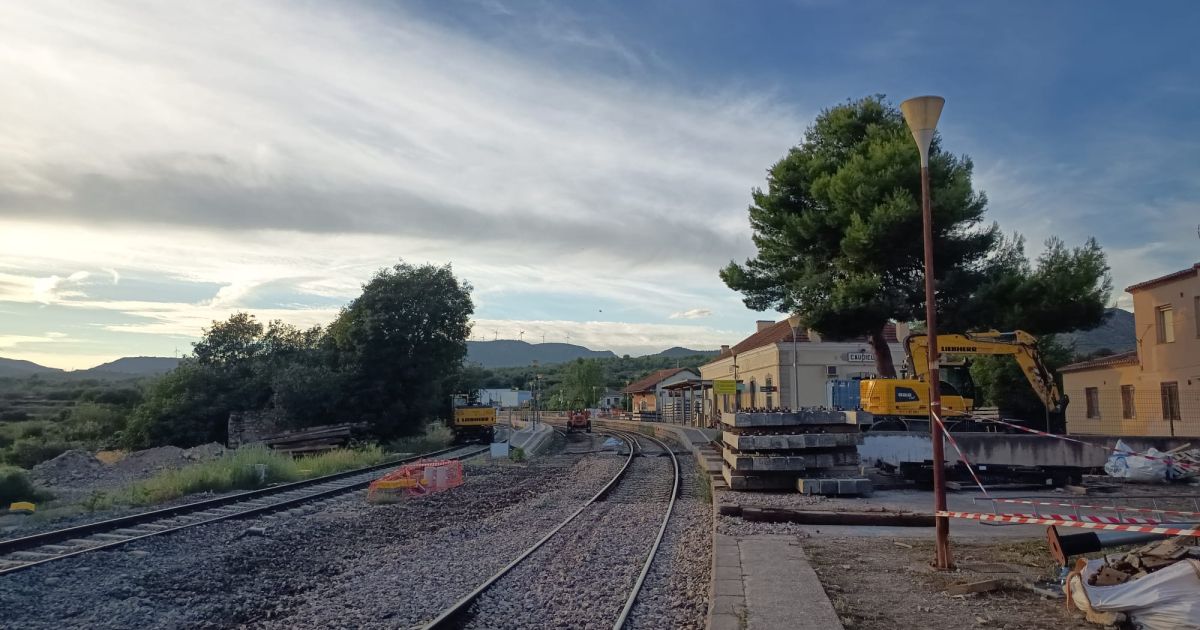
EUPV-IU in Alto Palancia, the district next to Sagunto, backs route option 1 for the Cantabrian-Mediterranean rail corridor, saying it is the only one that keeps the Sagunto-Teruel train service running.
Keep the train running as it does now, but improved: that, in short, is the position the EUPV-IU coalition in Alto Palancia has taken on the future route of the Cantabrian-Mediterranean rail corridor through this Castellón district next to Sagunto, between Soneja and Barracas. Spain's Ministry of Transport and Sustainable Mobility put forward two route options last July, and the left-wing party has openly backed the first.
The choice between the two options is not purely technical: it reflects a debate common to Spanish rail projects in recent decades, where entirely new routes tend to promise greater long-term speed and capacity, while upgrades to existing infrastructure prioritise keeping territorial coverage and avoiding the disconnection of towns that already have a station.
Rather than building an entirely new line, option 1 focuses on upgrading the existing route, keeping services running at current stations for both local and regional trains. An added argument in its favour, the coalition says, is that it would leave open the possibility of reopening currently inactive stops in future, such as Torás or Masadas Blancas.
Option 2, by contrast, would mean building a completely different line. EUPV-IU warns of a specific risk in that scenario: breaking the connection between municipalities in the middle of the district and those in the upper area, with the added risk of losing regional trains that currently link the area with Valencia and Aragón.
That concern is not unfounded in inland districts like Alto Palancia, where losing a rail service can accelerate depopulation by making it harder for people who work or study outside their town to commute daily — a pattern many inland districts across Spain have experienced after commuter and regional lines were cut or reduced.
Beyond the choice between routes, the coalition is calling for the electrification works already under way to be sped up, and for efforts to focus on increasing train frequency and renewing rolling stock, regardless of which route eventually wins out.
Electrifying a rail line, the other point EUPV-IU is pushing for, means replacing diesel locomotives with electric ones, which in practice translates into faster journeys, lower maintenance costs and a significant cut in polluting emissions compared with the diesel traction still used on much of this route. It is one of the most common structural investments in the Ministry of Transport's rail modernisation plans for inland Spanish lines with lower traffic density than the major high-speed routes. For Sagunto, which acts as a hinge between this inland line and the high-capacity network along the Mediterranean coast, fully electrifying the section would also make it easier to connect with the commuter services that already run electrically in the Valencia metropolitan area, cutting transfer times for people who combine both trains on their daily journey.
For regular users of the line, the choice between options 1 and 2 has, beyond the technical discussion, a very direct effect on their daily routine: keeping the current stations would mean not having to adapt to new access points or changes to connection times with Valencia's commuter trains — something especially relevant for those travelling daily for work or study.
Although the debate formally plays out on Castellón territory, its effects reach Sagunto directly: the town marks the southern end of this line and its connection point to Valencia's commuter rail network, meaning any decision on the Soneja-Barracas section also affects the service quality used by Camp de Morvedre residents travelling inland. EUPV-IU's position thus adds to a wider territorial debate over how to reconcile major European rail infrastructure with the everyday needs of the inland districts it passes through — a balance that will shape not only the future of the Cantabrian-Mediterranean corridor, but also public perception of whether such large projects genuinely benefit the areas they cross.
The project behind this local dispute goes far beyond a single stretch of track: the Cantabrian-Mediterranean corridor aims to connect cities including Valencia, Teruel, Zaragoza, Tudela, Logroño, Miranda de Ebro, Pamplona and Santander, is part of the EU's Trans-European Transport Networks (TEN-T), and its backers estimate it would eventually allow a Valencia-Bilbao journey of under four hours.
EUPV-IU itself is the Valencian federation of the United Left party, part of the national Unidas Podemos coalition since 2019. According to El Periódico de Aquí, with additional data from Wikipedia on the Cantabrian-Mediterranean corridor and EUPV-IU.