Sagunto council votes to back Ceuta and demand tough government action
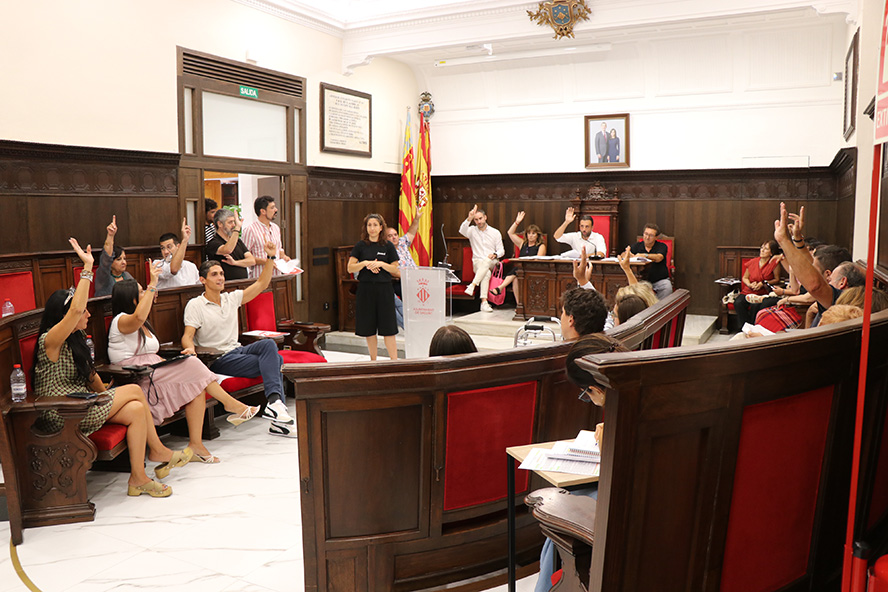
Sagunto's city council approved a motion in September, with votes from PSOE, PP, Iniciativa Porteña and Vox against opposition from Compromís and Podem, demanding the national government act firmly on Ceuta.
September's plenary session of Sagunto's city council exposed a clear political split: four groups backed a motion focused on Ceuta while two rejected it. The text, jointly filed by the People's Party (PP) and Vox and defended on the floor by councillor Ximo Catalán, called on the national government to take a tough stance on the migration crisis facing the autonomous city; an amendment from the Socialist Party (PSOE) was added before the vote. PSOE, PP, Iniciativa Porteña (a local Puerto de Sagunto party) and Vox voted in favour, while Compromís per Sagunt (a Valencian nationalist left coalition) and EU-Unides Podem (a left-wing alliance) broke away and voted against — unusual when an item outside direct municipal management reaches the agenda.
The debate stems from events of 30 July, when a large group of people, mostly from Morocco, entered Ceuta's territory all at once. According to the motion itself, this temporarily overwhelmed the city's capacity to respond: reception centres, everyday business activity and residents' routines were all affected, alongside extra strain on police, health and social services. The groups behind the motion wanted to formally acknowledge the National Police, the Civil Guard, the Armed Forces and humanitarian staff mobilised since then, and passed on concerns Ceuta's own assembly had already raised weeks earlier about the scope of the problem: from street safety and the daily running of basic services to health care, the local economy, jobs and, ultimately, coexistence and the country's overall security.
To put the city's scale in context: Ceuta had 83,595 residents according to Spain's National Statistics Institute (INE) 2025 register, a modest population that explains why the sudden arrival of several thousand people is so disruptive for its services. This is not the first time this border crossing has collapsed this way: back in May 2021, around 8,000 people — 1,500 of them minors — crossed irregularly within days, and Madrid returned about 4,000 to Morocco the following week. The precedent confirms that the fragility of this stretch of the Spain-Morocco border is not new but recurring.
The specific requests to the national government fall into three distinct groups. The first is about border security: repatriating, always within the law, those who took part in the 30 July episode and remain irregularly in the country; sufficiently expanding police and military personnel deployed along the border with Morocco; and strengthening, both legally and materially, the border's inviolability to prevent a similar event happening again. The second is about keeping institutions running: giving Ceuta's administration enough resources so that no public service stops working normally despite the extra pressure. The third combines economic and humanitarian concerns: specific aid to ease the blow to self-employed workers, businesses and employees in the city, together with a commitment to guarantee safety, wellbeing and rights for migrants still in the city while their administrative situation is resolved.
The text's underlying argument goes beyond the purely local: since Ceuta's border coincides with the European Union's external border, its backers argue that controlling it concerns the whole of Spain, not just Ceuta's regional administration. The motion also captures a sense of helplessness that, according to its supporters, Ceuta's residents felt in early July, when available resources fell short given the scale of events.
The agreement also backs solidarity demonstrations held on 2 September in various parts of Spain and calls, at both national and EU level, for a migration policy built on cooperation with countries of origin and transit, cracking down on people-trafficking networks, and effective border control within the law. It also asks Madrid to maintain constant dialogue with Ceuta's regional government, respecting its powers and particular circumstances, and calls on EU institutions for greater involvement with Ceuta and Spain. The text closes by requesting extraordinary funds to offset the economic, social and public-service impact left by the crisis, with special attention to the hardest-hit sectors.
In essence, Sagunto's plenary session brought a nationwide debate down to local level: those who backed the motion defended it as a matter of border security and institutional solidarity with Ceuta, while Compromís per Sagunt and EU-Unides Podem chose to distance themselves from that approach with their opposing vote. Sagunto City Council has no direct authority over events in Ceuta: its role is limited to formally forwarding the agreement to the Spanish government and EU institutions. According to Sagunto City Council, with additional background from Wikipedia on Ceuta and the 2021 migration crisis.