Sagunto council approves motion of solidarity with Ceuta's people
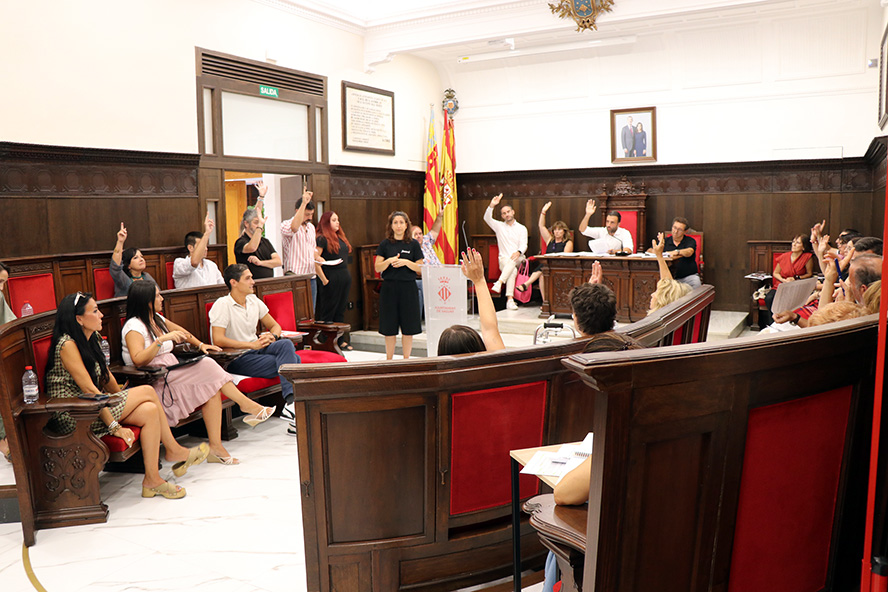
Sagunto's city council approved a motion in September, presented by left-wing party EU-Unides Podem, expressing solidarity with Ceuta; PSOE, Iniciativa Porteña and Compromís voted in favour, PP abstained and Vox voted against.
Sagunto's city council marked a clear four-against-two split in September: PSOE, Iniciativa Porteña, Compromís per Sagunt and the motion's own sponsor, EU-Unides Podem, pushed through a motion of solidarity with the people of Ceuta, while the PP chose to abstain and Vox voted against. EU-Unides Podem councillor Roberto Rovira defended the proposal on the floor.
The text's starting point is an act of remembrance: 141 people have died since 30 July trying to cross into Ceuta, and the council wanted this put on record as more than a statistic — real lives cut short that deserve memory and institutional recognition — alongside condolences to their families. The motion places that tragedy in a wider context: a small border city whose public services, businesses and community life have been overwhelmed, which its signatories say requires a joint response from Spain and the European Union.
The motion's concrete requests can be grouped into three strands. The first looks to Europe: it asks for a review of the model that outsources much of border control to third countries, and for progress towards a continent-wide migration policy grounded in human rights and shared responsibility among member states. The second focuses on Ceuta's daily reality: it calls on Madrid to respond quickly, provide more resources and arrange transfers to mainland Spain to ease pressure on the city, without giving up individual, fully-guaranteed handling of each case — asylum, reception, family reunification or return. The third centres on children: it calls for stable shared arrangements between the national government, Spain's regions and the two North African cities to care for minors arriving without family, with sufficient resources and the child's interests always placed ahead of political calculation.
That same section rejects automatic expulsions carried out without due legal safeguards, and reaffirms the council's commitment to asylum as a right and to not returning anyone without complying with international protection rules. The text also unreservedly condemns hate speech based on origin or race, along with any attempt to turn the migration crisis into electoral ammunition or a source of conflict between regions.
An unusual passage for this kind of municipal text is its direct rebuke of the FEMP (Federación Española de Municipios y Provincias — the national association of Spanish local governments): the council criticises what it calls the partisan use its Presidency has made of the Ceuta issue and demands it correct course, taking any institutional decision to debate among the groups that run the federation. It is worth recalling what that body is: founded in 1981, at its first assembly in Torremolinos (Málaga province), it has since brought together thousands of Spanish town and provincial councils to jointly defend municipal autonomy against other administrations — which explains why a perceived departure from that role is so sensitive for a council like Sagunto's.
The text also celebrates the thousands of people who took to the streets on 2 September in various Spanish cities in a show of support for Ceuta, and highlights those who keep Ceuta's daily life running from within: organised residents, social organisations and public employees who, the motion argues, should not have to shoulder a crisis of this scale alone. It is worth noting that the city has run under a distinctive system of government since 1995, when its Statute of Autonomy merged municipal and regional powers under a single mayor-president — which is why Sagunto's text is addressed to both its Presidency and its Assembly when calling for institutional dialogue.
The agreement is being forwarded, among other recipients, to the national government and the departments directly responsible — Foreign Affairs, Interior, Migration and Childhood — as well as to Ceuta's own Presidency, the Congress of Deputies, the European Commission, the FEMP and the Moroccan embassy in Spain. According to Sagunto City Council, with additional background from Wikipedia on the FEMP and Ceuta's Statute of Autonomy.