Sagunt a Escena festival closes 43rd edition with almost 11,000 spectators
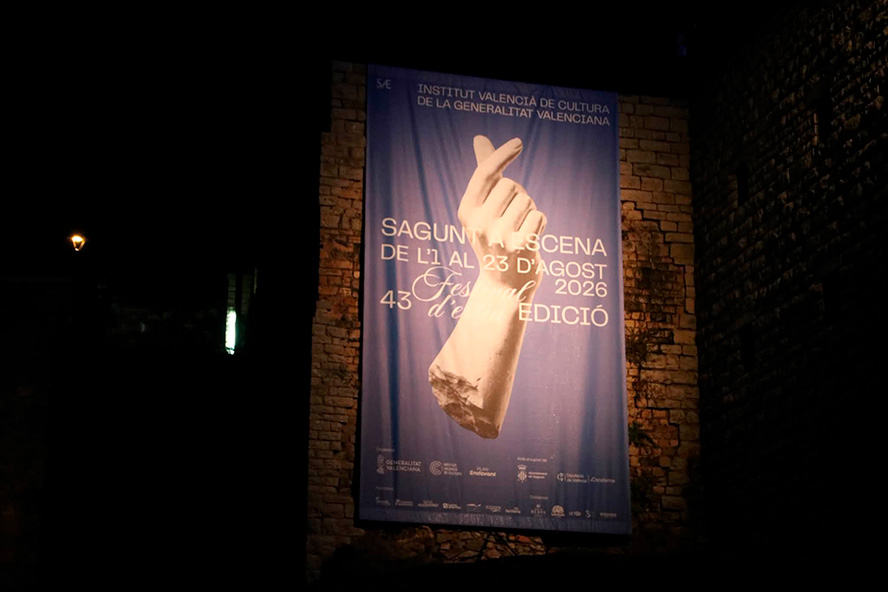
The performing-arts festival Sagunt a Escena closed its 43rd edition on 23 August 2026 with almost 11,000 spectators, five sold-out shows at the Roman Theatre and an expanded capacity of 804 seats.
Nearly 11,000 people went to the Roman Theatre and the streets of Sagunto this summer to see one of the twenty shows that made up the 43rd edition of Sagunt a Escena, a festival that closed on 23 August. Year after year, it has become a fixed date on the city's cultural calendar. The festival is run by the Valencian regional department of Education, Culture and Universities through the Institut Valencià de Cultura (IVC, the regional cultural institute), backed by the Valencia Provincial Council and Sagunto City Council. Nine of the shows took place inside the Roman Theatre itself; the other eleven made up the street programme Off Romà, spread across different spots in both parts of the city.
This year's key change was elsewhere: the Roman Theatre gained capacity, with nearly 200 more seats than in the previous two editions. The venue went from 608 seats in 2024 and 2025 to 804 in 2026, an upgrade funded by the regional Culture department through its Directorate-General for Cultural Heritage, working with the IVC. In practice, this meant many more people per show could get a seat without booking weeks ahead, which had been common in the two previous editions when capacity was smaller. This is not just any change to that venue: the renovation that gave the theatre its current look, carried out between 1990 and 1994 by architects Giorgio Grassi and Manuel Portaceli, was later ruled illegal by Spain's Supreme Court, which found that the work had been built directly on top of the Roman ruins, burying them under the new structure. Against that background, this year's extra seating simply made better use of the same building without reopening that old controversy. The Roman Theatre, which also regularly hosts other performing-arts events throughout the year, is confirmed as Sagunto's main cultural hub during the summer months.
A concert by flamenco singer Estrella Morente closed the theatre's regular season and was one of five shows that sold out completely, alongside La ópera de los tres centavos, La dama boba, Terra de guapes and Fedra, en los infiernos. Together, the eight big-format shows at the Roman Theatre drew 7,000 spectators. Other productions also filled seats: Original Greek, staged by Valencian artist Marina Toniovic, and Hamlet, una versión recontralibre, with performers from Teatro La Plaza, a company from Peru. Also well attended were the two performances of El Narciso en su opinión, an IVC production based on a text by Guillén de Castro, adapted by Chema Cardeña and directed by Rebeca Valls. Those last two productions were backed by the Valencia Provincial Council's theatre department and the Centre Teatral Escalante. Sagunto City Council, for its part, helped organise both Off Romà and Terra de guapes, written by Sandra Monfort.
The festival's other big strand, aimed at people who prefer to watch theatre without paying for a ticket, was Off Romà, which drew around 4,000 people to squares and streets across the city. Fourteen of this year's productions were made by Valencian artists: three were staged inside the Roman Theatre, and eleven were part of the street circuit, with dance, circus and theatre proposals from all three Valencian provinces, driving attendance to record levels. New this year were two large-scale street productions: Quimera, by La Fam Teatre, and Carrer 024, by Sol Picó, which filled squares with crowds in both parts of the city.
The street programme was spread across eight different spots, including squares, gardens and the Pantalán seafront walkway. At the Alameda (a tree-lined avenue), Marea Danza presented Anudar and La Fam Teatre premiered Quimera; at the central Plaza Cronista Chabret, Colectiv Notknown staged Caso enterrado, while I si fem un clàssic, by Visitants, had to be cancelled after one of its performers fell ill. Carrer 024 was chosen to close the festival, on 23 August itself, at the historic Plaza Antigua Morería, which also hosted Juga, by La Trócola Circ. Rain stopped the performance of Rob, by Teatre de l'Abast, which had been due to take the stage at the Centro Cívico (civic centre). At the Casa Municipal de Cultura, Bramant Teatre and Escalante staged Princeses, cavallers i dracs; Plaza dels Tarongers marked La Siamesa's 20th anniversary with Bailarina a la carta; and Koosha, by El Cruce, closed the street route at the nearby Casa dels Berenguer.
For the second year running, the festival repeated its social outreach effort: InsProject, a Sagunto-based association that supports people with disabilities, joined a three-day movement workshop led by choreographer Ana Lola Cosín Torada and dancer Lucas García, at that same municipal cultural centre. The twelve participants ended the experience by watching Hamlet, performed by actors with Down syndrome from Teatro La Plaza.
With more than thirty editions behind it, Sagunt a Escena has earned a place among the leading performing-arts festivals in the Valencian Community, according to the IVC itself. That track record helps explain why, every summer, the festival manages to bring together big national names and up-and-coming local companies, something few festivals of similar size manage to keep up year after year. Behind the event was also the regional government, through its Plan Endavant funding programme, and a long list of sponsors: from Sagunto's tourism department to firms such as Caixa Popular and the Valenciaport port authority, as well as Saggas, Fertiberia, Vivavins, La Serp, Le Fou, Panach and Royal Bliss.
According to data from Sagunto City Council, with contributions from El Periódico de Aquí, from Wikipedia on the archaeological site's background, and from the IVC on the festival's history.