Sagunto holds a minute of silence for women killed in Murcia and Llanes
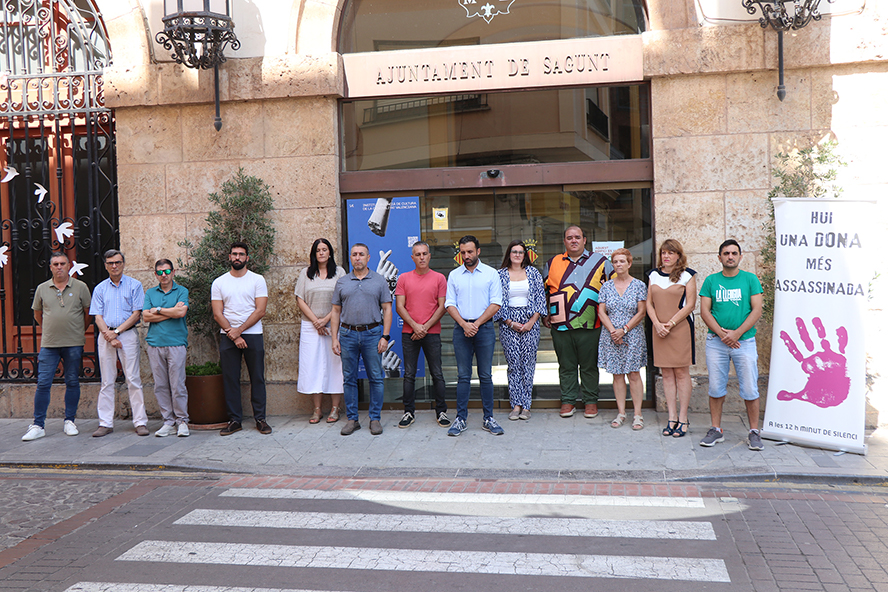
Sagunto City Council held a minute of silence outside its public buildings on Friday 7 August to condemn the suspected gender-based killings of a 44-year-old woman in Murcia and a 50-year-old woman in Llanes, Asturias.
Sagunto City Council's Equality Department called a silent gathering outside the town hall's public buildings on Friday 7 August at midday. The gathering condemned two suspected gender-based killings ("feminicidios") reported that week: the murder of a 44-year-old woman in Murcia and of a 50-year-old woman in Llanes, in the northern region of Asturias. Neither case is directly linked to Sagunto, but the council followed a practice common among Spanish town halls, which organise this kind of public condemnation every time a new femicide is confirmed or suspected anywhere in the country. The gesture itself lasts only a few minutes.
The call was answered by representatives of every political group on the City Council, council staff, several local associations, and residents who joined individually for the minute of silence. The joint presence of all parties showed the broad agreement this issue generates in Sagunto's town hall, beyond the usual political divides. This kind of gathering is becoming worryingly frequent in the city: just two days earlier, on 5 August, a similar concentration outside the same buildings condemned the suspected murders of women in Barcelona and Santander, making this the second such act in under a week.
The council statement used the occasion to recall official national figures on gender violence. According to that data, 2025 ended with 47 women killed by gender violence across Spain, while the count for 2026 already stood at 35 by the date of the statement. Since 2003, when the state began recording the figures, 1,376 femicides have been logged. The statistics also include 68 minors killed since 2013 as direct victims of this violence, and note three cases of "vicarious violence" already recorded in 2026, killings in which an abuser targets children to inflict harm on the mother. These national figures come from the Government Delegation against Gender Violence, the same body that oversees the 016 helpline mentioned below, and are updated as new cases are confirmed by courts across the country.
The official portal of Spain's Ministry of Equality updates its count almost daily. At the time of consulting it, the portal put the total at 1,377 killings since 2003, just one more than the figure quoted by the council, which shows how fast that running total moves from week to week. The same portal also gives a sense of how heavily the 016 helpline is used. This is the free, confidential phone line that the council statement recommends for anyone who suspects gender violence, whether they are directly affected or not. Between its launch on 3 September 2007 and 30 June 2026, it received 1,524,412 calls across Spain, of which 62,302 came in the first half of this year alone, a volume that shows the scale of the problem beyond the cases that make headlines.
The Equality Department stresses that anyone who suspects gender violence, whether the victim herself or someone close to her, has a civic duty to report it, either by calling 016 or 112 (the general emergency number). Callers do not need to be victims themselves to use the line; the service is also meant for relatives, friends, neighbours or colleagues who suspect something is wrong. In Sagunto, the Women's Support Service sees people in person Monday to Friday, by appointment via phone (96 265 58 89) or WhatsApp (607 248 363), from 8:00 to 15:00, or by email at [email protected]; urgent cases are also seen without an appointment.
For serious emergencies, the council points to 112, the National Police (091 or 96 267 00 91, Spain's main urban police force handling serious crime), the Local Police (092 or 96 265 54 84, Sagunto's own municipal force), and the Civil Guard (062, the national police body that covers rural and smaller towns). Women needing urgent help can also contact the Centre Dona 24 Hores ("24-hour Women's Centre"), a service run by the Valencian regional government, on 900 580 888, or call 016 directly. Both calls are free and do not appear on the phone bill, though the council reminds callers it is still worth deleting the number from the phone's call log for safety, in case an abuser has access to the device. According to aytosagunto.es, with additional data from Spain's Ministry of Equality.