Lydia Bosch and Julio Peña star in 'Fedra' at Sagunto's Roman Theatre
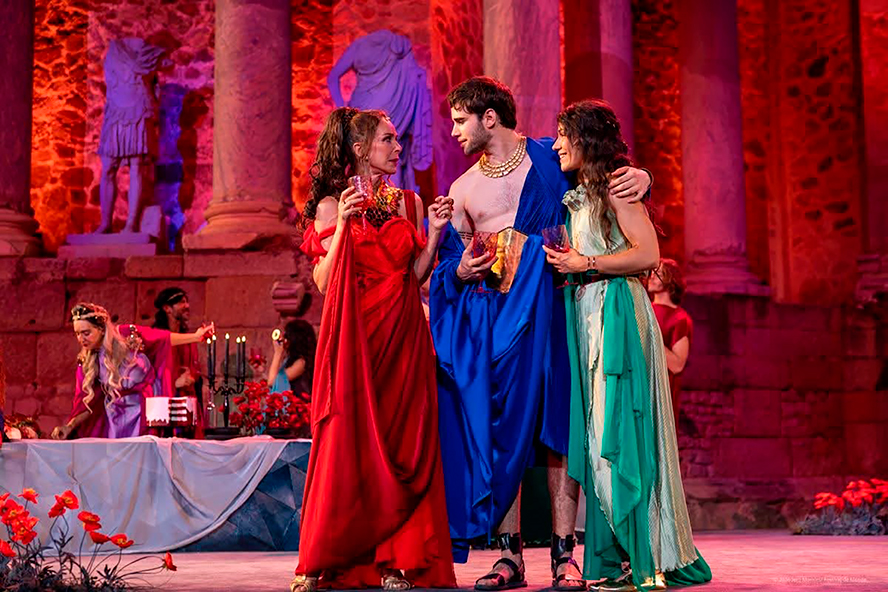
The Sagunt a Escena festival stages 'Fedra, en los infiernos' on 20 August at 22:30, starring Lydia Bosch and Julio Peña, while the free Off Romà programme brings giant dragons to the streets of Puerto de Sagunto.
Sagunto and Puerto de Sagunto's cultural calendar reaches its most anticipated moment of the summer this week: on 20 August at 22:30, the Roman Theatre hosts 'Fedra, en los infiernos' ('Phaedra, in the underworld'), led by Lydia Bosch with Julio Peña as Hippolytus, as part of the 43rd edition of the Sagunt a Escena festival. The production is directed by José María del Castillo, who also wrote the script giving this Greek myth a contemporary twist.
The plot brings Phaedra back after she strikes a deal with the Moirai, the goddesses of fate, to rewrite her story and find the peace denied to her in her first life — a life marked by an impossible love for her stepson. Passion, forbidden desire, guilt turned into sin and moral judgement run through this retelling, which stays true to the tragic tone of the original myth.
The production is backed by the Conselleria de Educación, Cultura y Universidades (the Valencian regional department for education and culture), which organises the festival through the Institut Valencià de Cultura (IVC — Valencian Institute of Culture) together with the Provincial Council of Valencia and Sagunto City Council. With more than thirty editions behind it, Sagunt a Escena has earned a fixed place on the Valencian cultural calendar — and it does so on a stage with its own history: the Roman Theatre, built around the middle of the 1st century, roughly 50 AD, although work began under Emperor Augustus and was not finished until the reign of Tiberius. Almost two thousand years on, its stone tiers still host live tragedy every summer in front of thousands of spectators.
The festival's split venues are no accident: ticketed shows like Fedra are concentrated in the archaeological site in the historic town centre, while the free programme actively reaches out to audiences in Puerto de Sagunto, bringing the show to the Alameda promenade and the Casa Municipal de Cultura. That combination — Roman heritage on one side of the municipality, street life and neighbourhood venues on the other — captures the two faces of a town that residents often experience as two separate places under one council.
Before the curtain rises on Fedra, the festival runs its free Off Romà programme, led this year by two very different dragons. The first arrives on Wednesday 19 August at 21:00 at the Alameda promenade in Puerto de Sagunto (Sagunto's coastal district): 'Quimera', a street parade by Castellón company La Fam featuring an articulated creature — six metres tall, twelve metres long and weighing close to 1,500 kilograms, built from iron, wood and leather — that moves through the streets in the hands of four performers, drawing on street-level mythological imagery.
The second dragon appears the following day, 20 August at 22:00, at Puerto de Sagunto's Casa Municipal de Cultura (municipal culture house), with 'Princeses, cavallers i dracs' ('Princesses, knights and dragons'). The co-production by Bramant Teatre and Escalante Centre Teatral, written and directed by Jerónimo Cornelles, opens with a school museum visit that turns into an incident — someone throws a drink at a painting of Saint George defeating the dragon — and uses it to explore the prejudices faced by teenagers and young people, blending text, image, music and movement.
These have not been the only highlights this month: Sagunt a Escena's line-up has also included musician Coque Malla in 'La ópera de los tres centavos' ('The Threepenny Opera'), a version of 'Hamlet' performed by actors with Down syndrome, and the comedy 'Original Greek' — proof that this edition moves comfortably between musical theatre, socially engaged drama and comedy.
One detail worth noting: all three shows are scheduled for the evening, between 21:00 and 22:30, as a heatwave moves through the district these days; the last part of the evening is, by far, the most comfortable time both for the audience in the Roman Theatre's stone seats and for anyone following the Quimera street parade on foot through Puerto de Sagunto.
For residents of Sagunto and Puerto de Sagunto, Fedra rounds off an intense week of free and ticketed culture, centred on the Roman Theatre and the Alameda promenade. Tickets for the performance can be booked through the festival's usual channels; the two Off Romà shows, by contrast, need no ticket and are open to everyone. According to Sagunto City Council, with additional information from the Institut Valencià de Cultura (IVC) and Wikipedia's entry on the Roman Theatre.